

Camp nine, p.1
Camp Nine, page 1
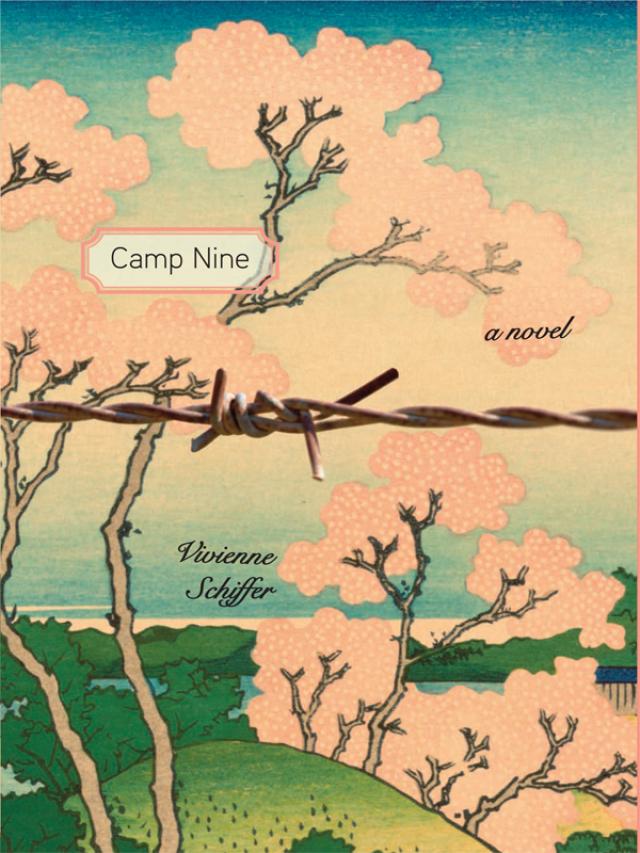


Camp Nine
Camp Nine
A Novel
Vivienne Schiffer
The University of Arkansas Press
Fayetteville
2011
Copyright © 2011 by The University of Arkansas Press
All rights reserved
Manufactured in the United States of America
ISBN-10: 1-55728-972-7
eBook ISBN-13: 978-1-55728-972-8
15 14 13 12 11 5 4 3 2 1
Designed by Liz Lester
The paper used in this publication meets the minimum requirements of the American National Standard for Permanence of Paper for Printed Library Materials Z39.48-1984.
LIBRARY OF CONGRESS CATALOGING-IN-PUBLICATION DATA
Schiffer, Vivienne, 1959–
Camp nine / Vivienne Schiffer.
p. cm.
ISBN 978-1-55728-972-8 (cloth : alk. paper)
1. Japanese Americans—Evacuation and relocation, 1942–1945—Fiction. 2. Arkansas—Fiction. I. Title.
PS3619.C366C36 2011
813'.6—dc23
2011029104
Contents
Acknowledgments
Application for Leave Clearance
Chapter 1
Chapter 2
Chapter 3
Chapter 4
Chapter 5
Chapter 6
Chapter 7
Chapter 8
Chapter 9
Chapter 10
Chapter 11
Chapter 12
Chapter 13
Chapter 14
Chapter 15
Chapter 16
Chapter 17
About the Author
ACKNOWLEDGMENTS
Although it was inspired by the realities of the Japanese American internment camp experience in Arkansas, Camp Nine is purely fictional. It is true that I was born and largely raised in Rohwer, Arkansas, and the fictional town of Rook that Camp Nine describes is very much like the Rohwer of my childhood. We did live next to my grandparents, who were prosperous planters. But they were kind and generous people, as was my late father’s only sister, who was and is the complete opposite of the aunt in Camp Nine. No parallels between these characters and real people should be drawn. The same must be said for all the characters of Camp Nine.
Many people were responsible for Camp Nine seeing the light of day. First was Valerie West, my extraordinary screenwriting professor at the University of California at Los Angeles, who insisted I must tell a story based on the improbability of nearly ten thousand Americans of Japanese descent suddenly appearing in the Arkansas Delta during the 1940s. But it would never have gone any farther than my imagination had it not been for the support of my wonderful agent, Brettne Bloom of Kneerim and Williams, who continued to believe in this story when many others would have given up. Many thanks, also, to Lorna Owen, whose kind words and encouragement kept me going, and whose editorial prowess whipped earlier drafts into prime shape.
I will always be grateful to Larry Malley of the University of Arkansas Press, who, despite his unfortunate Yankee upbringing, got down here to the South as fast as he could and continues to make it a better place. And especially to David Stricklin of the Butler Center for Arkansas Studies for his interest in Arkansas’s internment camps and his kindness to my family.
Mary and Laine Lindsey read the first draft of Camp Nine and not only provided marvelous feedback, but offered unbridled enthusiasm. I’m indebted to my friends at Thompson and Knight, among them Bill McDonald, David Furlow, Jim Cousar, Nichole Olajuwon, and Marlen Whitley. And Brettne wouldn’t have been possible without her lovely parents, Steve and Janis Block.
So many people were there during the writing of Camp Nine offering encouragement, including Rick and Cindy Trevathan, Terrye Dees, Bill and Beth Maher, Diane Hernandez, Ken and Anita Magidson, Gus and Callie Saper, Diane Anderson, James Lowe, and Donna Hammond. Thank you all.
I also want to express my gratitude to my new friend, John Carrithers, for his appreciation of the beauty of the Rohwer camp site and the significance of what happened there so many decades ago.
Unlimited thanks to my mother, Rosalie Santine Gould, who inspired so much of Camp Nine, and without whose efforts to preserve the Japanese American experience in Arkansas, the memories would have stayed fragmented and been forever lost. Thanks also to my brothers, Clayton Gould and Mitch Gould, for sharing our Rohwer childhood.
But no words can completely express my gratitude to and for my family: my sons Adam, Jake, and Wyatt; my daughter, Samantha; my daughter-in-law, Libby; my son-in-law, Shawn; my grandsons, Kai and Braiden; my niece, Liz; and my nephew, Gifford.
As much as I love and appreciate everyone on this page, however, if I could only mention one person to whom I owe everything, here he is: my husband, Paul Schiffer. Thank you, Paul, for supporting everything I set my mind to doing. I love you.
This book is dedicated with love and devotion to the Infant of Prague.
Camp Nine
APPLICATION FOR LEAVE CLEARANCE:
QUESTION #27:
Are you willing to serve in the armed forces of the United States on combat duty, wherever ordered?
QUESTION #28:
Will you swear unqualified allegiance to the United States of America and faithfully defend the United States from any or all attack by foreign or domestic forces, and forswear any form of allegiance or obedience to the Japanese Emperor or any other foreign government, power, or organization?
Rook, Arkansas, 1965
These are the parts of my life: before Camp Nine and after Camp Nine, and those brief, unexpected days when Camp Nine was everything to me. That I was only a child then, and that most of the details that make a person whole still lay before me, doesn’t change things. When I look back, everything is divided into those three, distinct times.
I sit on a concrete bench in the shade of a cherry tree, now a graceful giant, its black branches adorned with the pale pink blossoms that will last only a few days, my eyes trained down the single lane dirt road that leads to the railroad tracks. A decaying brick smokestack rises at the edge of the bayou, one of the last reminders that there was once a city on this empty plot of land.
Camp Nine is gone. As a girl teetering on adulthood, I watched it disintegrate, vanishing just as quickly as it had come, until all that remained were the field and my memories. I own this land now. And I own those memories, which I guard carefully, even from those closest to me.
I check my watch again. David’s telegram said nothing more than that he would arrive today sometime after noon, and it is now one thirty. His cryptic message, delivered in short bursts of words like Morse code, simply said when, not why. With nowhere to reply, I am left to wonder.
Like everyone who watches television and reads Life magazine, I know that David Matsui lives a fashionable life in London, where his concerts entertain royalty and his shows sell out the Royal Albert Hall. The official story of his rise to fame recounts his improbable discovery one night at a Chicago club while he worked in a meatpacking plant by day, his virtuosity at the guitar, and his meteoric popularity among that new breed of snobs known as blues purists. But Camp Nine is never a part of the story. Famously private, David doesn’t talk about his parents, or his older brother, who was once his hero and his best friend.
But I’m guilty of harboring his secret as well. Although I live a scant ten miles from where rows upon rows of barracks once stood, my husband and daughters have only the vaguest idea of what happened at Camp Nine, and perhaps sensing my reluctance to open up about certain events in my past, they never plumb me for details. I have never mentioned David Matsui’s name.
None of us who were there ever speaks of what happened during those strange, anxious months, as if the whole affair were a dream that didn’t come true. But the Delta is mysterious, the kind of place where so many things happen that go unnoticed by the outside world. The overwhelming stillness of the countryside and the oppressive flatness of the terrain, cleared almost entirely now of trees, slow the passage of time. The air is molasses in summer, an iron blanket of cold in the winter. The vast landscape tricks the mind into thinking that gravity is somehow stronger here, that the bayous and the canebrakes can pin you against them so that even light can’t escape.
I did my best to break free, choosing a faraway girls’ college up north where my slow, languid way of speaking and my narrow, provincial views made me an easy target for the sophisticated girls from Boston and Philadelphia. Their scoffs and sneers were a shock to me, since my mother and I had passed for liberal thinkers down in the Delta. I stayed away only as long as I had to, then gazed out the window with anticipation the whole of the long, last train ride home, my pulse slowing once the familiar scenery came into view.
I can’t imagine what David wants after all this time. He spent the entirety of his days at Camp Nine struggling to get away, and as the years passed with no word from him, I often wondered if he ever thought of us. His telegram gave me the answer to that much, at least. There were times when I longed to find him. I wanted to ask him how he could have turned his back on everything that had happened. But it was pride that kept me from reaching out. After all we had done for David and his family, everything I thought we had meant to them, if they didn’t think enough of us to have kept in touch, well, then what was the point?
But my nerves have gotten the better of me now. Whatever his reasons for coming, I have my own for anxiously awaiting him. And as a plume of dust appears on the horizon and a ca r snakes its way toward me, I remember when it all began.
Chapter 1
To understand the story, one must understand the place, for the events could not have transpired anywhere else. Just as the beginning of life itself was dependent on the peculiar environment that made possible its first spark and flash, the story of Camp Nine is a product of the surroundings in which it occurred.
The afternoon it happened, in July of 1942, my mother and I had taken our dinner of watermelon and toast on the porch. Both the menu and the location were, in themselves, manifestations of that custom known as summer, where conversations were shorter and slower. The heat, a tiresome, unwelcome guest in every room, drove us outdoors into the shade whenever possible, and dictated a conservation of energy from the earliest hours. It spread over us at sunrise, informing our dreams before we’d even roused from sleep, and sapped our strength at noontime. By suppertime, few philosophies were so keenly felt that one could be compelled to expend the breath to argue. Even our nighttimes, spent tossing in our beds, were made fitful by the heaviness of the air.
I was an odd child, tall for my age and gangly, the color of October wheat. My plain features were not improved by my uneven, homemade pageboy haircut. I might have found comfort in having inherited the exotic black silk of my mother’s hair or the patrician blond of my father, but I was dealt instead a mousy and unremarkable brown. My eyes were the deepest, impenetrable black, the kind that took in light but reflected nothing in return. Everything about me seemed to fade into the wallpaper around me. I studied my beautiful mother’s habits, observing her closely for clues on how I, too, could be as fine a lady as she, but it seemed then impossible to attain. I could follow her, but only as a shadow.
She was a lovely woman, despite the gray, shirtwaist dress she wore as regularly as a uniform. In those days before Camp Nine changed everything, gray and black were the only colors I recall her wearing, as if she were still in mourning for my father, who by then had been dead for more than five years, or trying to mask the fact that she had once been, and still was, regarded as a great beauty. Her dark eyes were the shape of almonds, and her thick brows were curved and peaked, giving her the appearance when she spoke of being extraordinarily attentive. She wore her lush hair pulled back loosely, the ends curling slightly across the plain fabric on her shoulders.
Mother and I took our dinner in small, languid bites. My thoughts at that moment are frozen in time: I was studying a red wasp navigating the spiny crown of a purple coneflower. I don’t know what Mother was thinking. She was probably already contemplating what we would have for our supper. In any event, the last normal, ordinary thing that happened was that my grandfather’s black Lincoln Continental emerged from the cypress bend in Rook Lane and barreled past in a cloud of dust. The wall clock inside our living room sounded once to note the hour.
Mother shook her head. “Dinner time in the big house. You can set your watch by Walter’s stomach.”
No matter where in the county he was when dinner time approached, my grandfather appeared every day precisely at one o’clock, as if he had internal springs and dials. The Lincoln slowed and bounced up into the concrete drive across our gate, disappearing from view behind a grove of oaks.
Mother and Grandpa feuded famously, about things trivial and important alike. Though she was only his daughter-in-law, I now realize they were more alike than not, but at the time that was one of the many things about which I was unaware. I was just twelve that summer, but Mother often treated me as if I were much older, probably because she had no one else with whom to share her thoughts. She had confided in me that her latest quarrel with Grandpa was over Hammond Ryfle, our plantation foreman.
Mr. Ryfle was supposed to have already cleared Mother’s hundred acres upstream of Black Bayou, but spring had come and had passed without him attending to it. He was, instead, occupied with clearing the poorest of my late father’s land, a large plot of virgin timber and swamp that was known as Camp Nine. He swore it was on instruction by Grandpa, whose refusal to answer Mother’s questions aggravated her like a knotted neck muscle. Just seeing Grandpa’s Lincoln pass caused her lips to draw up tight.
“Is Mr. Ryfle all done at Camp Nine?” I asked.
Mother leaned back and set her plate, littered with rind and crust, on one of the glass-topped wicker end tables that flanked the flowery cushioned swing. “I saw him driving the bulldozer off yesterday,” she said, flicking a stray crumb from her lap into her hand and crushing it with a napkin. “It’s too late to plant anything, but I suppose he could start laying by the fields. I don’t know what Walter’s got planned.” She gathered a corner of the napkin and worried it into the table, wiping the ring left by her iced tea glass. “I quit asking.”
We rocked for a few minutes, occupied by our own thoughts in the pleasant quiet, but then it happened. A faint sound rose in the distance, down Highway 1, a tiny rippling of the air that was unfamiliar. We looked at each other, Mother frowning.
“What’s that?” I asked.
She blinked in consternation, less alarmed than puzzled. “Sirens?” she ventured.
Try as I might now, I can’t say that I had ever heard a siren anywhere other than from the radio shows I loved to listen to at night, while the crickets sang outside. There was no police force or hospital in our town of Rook. We never had emergencies that required any hurry, and if we had, our lack of basic infrastructure would have left us unable to respond with sirens. But as the alien sound approached, the whirring turned into an ear-splitting cry. I scrambled to the edge of the porch and pressed my nose against the screen, staring through the pale pink and blue hydrangeas, fascinated by the novelty but unwilling to leave the safety of the house.
Two state trooper vehicles passed on the highway, lights flashing. They moved slowly, crawling to a stop at the dirt road that crossed the tracks, leading to Camp Nine. Behind them bundled a line of twenty or thirty trucks, each bearing a long trailer piled with mountains of lumber.
“What on earth?” Mother shouted, wrenching the screen door nearly from its hinges and taking the steps down into the brittle yard. I thought she might be heading on foot to Camp Nine, but as I sprinted behind her, she turned and marched the length of Grandpa’s driveway, pausing only once to take in the spectacle of the procession passing through town and vanishing from our sight.
She burst through the door of Grandma’s cookhouse and stalked to the middle of the room, but I remained just inside the door, obscuring myself in the shadow of a punched-tin pie safe. Grandpa sat hunched over a wooden table draped by a worn checkered oil-cloth. Odessa, my grandmother’s housekeeper, stood before the sink, her hands submerged in soapy water. She was startled by our sudden intrusion, but Grandpa pretended to notice nothing.
We were all accustomed to knock-down, drag-out fights between Mother and Grandpa. With his only son dead and gone, Grandpa now had to deal with Mother in matters of my father’s estate, which included me. Their sensibilities could not have been more opposed, but I believe that deep down, he admired her spunk and spark. What was certain was that he enjoyed a skirmish with her as much as a good bird hunt.
“Walter?” Mother demanded. “What in hell is going on over there?”
Odessa pulled her hands from the water and ran them over her apron, then made a hasty exit out the back door and onto the wash porch. Grandpa’s eyes darted sideways at Mother, but the fork continued its arc into his mouth. He chewed and glanced at a clock. “Less than five minutes,” he said, swallowing. “That’s some kind of record, even for you, Carrie Morton.”
Whatever was happening at Camp Nine was something Grandpa had orchestrated, and she demanded to know what he had planned. In my lifetime, not so much as a new house had been constructed in Rook, and the lumber being delivered that very moment was enough to build an entire city.
Grandpa set down his fork and lifted a linen napkin. “You know, yourself Carrie, that land my son bought has no value for farming. It’s as worthless as a Confederate dollar.”






