The edge of summer, p.1
The Edge of Summer, page 1


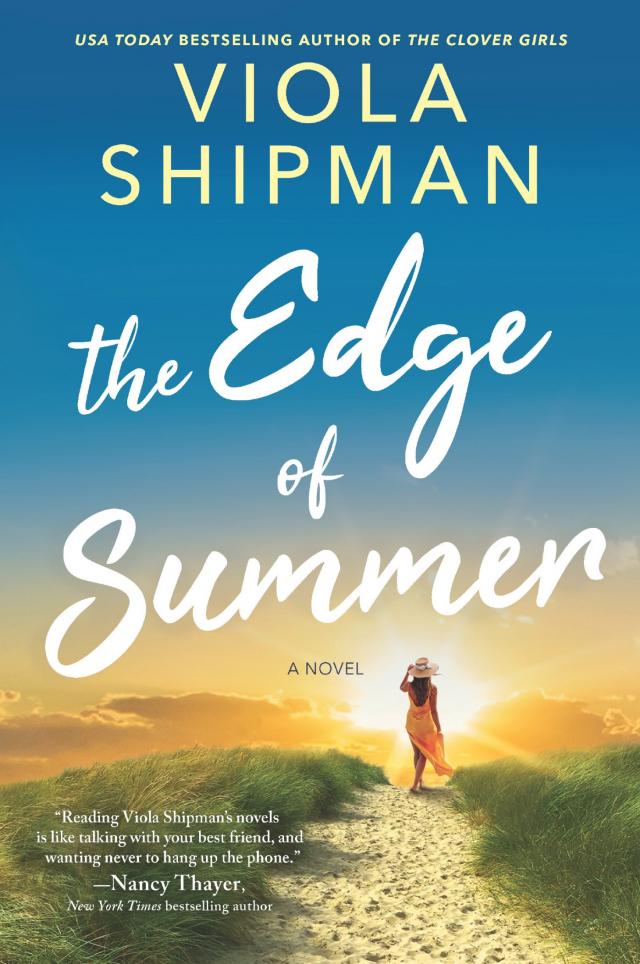
Praise for the novels of Viola Shipman
“Viola Shipman knows relationships. The Clover Girls will sometimes make you smile and other times cry, but like a true friendship, it is a novel you will forever savor and treasure.”
—Mary Alice Monroe, New York Times bestselling author
“Viola Shipman has written a love song to long-lost friends, an ode to the summers that define us and the people who make us who we are. The minute I finished The Clover Girls, I ordered copies for all my friends. It’s that good.”
—Kristy Woodson Harvey, New York Times bestselling author
“Reading Viola Shipman’s novels is like talking with your best friend and wanting never to hang up the phone. The Clover Girls is her most beautiful novel yet, and her most important.”
—Nancy Thayer, New York Times bestselling author
“Oh, the joy! The Clover Girls may be [Shipman’s] best yet, taking readers on a heartwarming trip down memory lane... Ideal for summer... A redemptive tale, celebrating the power of friendship while focusing on what matters most. Perfect for the beach!”
—New York Journal of Books
“Every now and then a new voice in fiction arrives to completely charm, entertain and remind us what matters. Viola Shipman is that voice and The Summer Cottage is that absolutely irresistible and necessary novel... [It] brings us the astounding importance of home and underscores the importance of a loving family and of having a generous heart. Grab a glass of sweet tea and enjoy!”
—Dorothea Benton Frank, New York Times bestselling author
“Shipman’s evocative novel is a love letter to Michigan summers, past and present, and to the value of lifelong friendships. A blissful summer read sure to please the author’s many fans, and fans of writers like Elin Hilderbrand or Kristin Hannah.”
—Library Journal on The Heirloom Garden
“The emotional scars left by war unite two women, generations apart, in Shipman’s sentimental family saga... The Heirloom Garden successfully captures these women’s resilience and their hopeful desire for new beginnings.”
—Publishers Weekly
Viola Shipman is the pen name of Wade Rouse, the USA TODAY bestselling author of twelve books, including The Secret of Snow and The Clover Girls. Rouse chose his grandma’s name, Viola Shipman, as a pseudonym to honor the woman whose heirlooms inspire his fiction. He lives in Michigan and California, and hosts Wine & Words with Wade, a literary Happy Hour, every Thursday.
www.ViolaShipman.com
Viola Shipman
The Edge of Summer
For my grandmothers,
who taught me the little things always matter most in life
Contents
Quote
Prologue
Chapter 1
Chapter 2
Chapter 3
Chapter 4
Chapter 5
Chapter 6
Chapter 7
Chapter 8
Chapter 9
Chapter 10
Chapter 11
Chapter 12
Epilogue
Author Note
Acknowledgments
Reader’s Guide - The Edge of Summer
Discussion Guide Questions
Excerpt from A Wish for Winter by Viola Shipman
“Buttons are the fossils of the sartorial world,
enduring long past the garments they
were designed to hold together.”
—MARTHA STEWART
Prologue
BUTTONHOLE
A small cut in the fabric that is bound with small stitching.
The hole has to be just big enough to allow
a button to pass through it and remain in place.
My mom told everyone my dad died, along with my entire family—grandparents, aunts, uncles, and all—one Christmas Day long ago.
“Fire,” she’d say. “Woodstove. Took ’em all. Down to the last cousin.”
“How’d you make it out with your little girl?” everyone would always ask, eyes wide, mouths open. “That’s a holiday miracle!”
My mom would start to cry, a tear that grew to a flood, and, well, that would end that.
No one questioned someone who survived such a thing, especially a widowed mother like Miss Mabel, which is what everyone called her out of deference in the Ozarks. Folks down here had lived hard lives, and they buried their kin just like they did their heartache, underneath the rocky earth and red clay. It took too much effort to dig that deep.
That’s why no one ever bothered to check out the story of a simple, hardworking, down-to-earth, churchgoing lady who kept to herself down here in the hollers—despite the fact me and my mom both just appeared out of thin air—in a time before social media existed.
But I did.
Want to know why?
My mom never cried.
She was the least emotional soul I’d ever known.
“How did you make it out with me?” I asked her countless times as I grew older, when it was just the two of us sitting in her sewing room in our tiny cabin tucked amongst the bluffs outside Nevermore, Missouri.
She would never answer immediately, no matter how many times I asked. Instead, she’d turn over one of her button jars or tins, and run her fingers through the buttons as if they were tarot cards that would provide a clue.
I mean, there were no photos, no memories, no footsteps that even led from our fiery escape to the middle of Nevermore. No family wondered where we were? No one cared? My mother made it out with nothing but me? Not a penny to her name? Just some buttons?
We were rich in buttons.
Oh, I had button necklaces in every color growing up—red, green, blue, yellow, white, pink—and I matched them to every outfit I had. We didn’t have money for trendy jewelry or clothes—tennis bracelets, Gloria Vanderbilt jeans—so my mom made nearly everything I wore.
Kids made fun of me at school for that.
“Sutton, the button girl!” they’d taunt me. “Hand-me-downs!”
Wasn’t funny. Ozarks kids weren’t clever. Just annoyingly direct, like the skeeters that constantly buzzed my head.
I loved my necklaces, though. They were like Wonder Woman’s bracelets. For some reason, I always felt protected.
I’d finger and count every button on my necklace waiting for my mom to answer the question I’d asked long ago. She’d just keep searching those buttons, turning them round and round, feeling them, whispering to them, as if they were alive and breathing. The quiet would nearly undo me. A girl should have music and friends’ laughter be the soundtrack of her life, not the clink of buttons and rush of the creek. Most times, I’d spin my button necklace a few times, counting upward of sixty before my mom would answer.
“Alive!” she’d finally say, voice firm, without looking up. “That’s how we made it out...alive. And you should feel darn lucky about that, young lady.”
Then, as if by magic, my mom would always somehow manage to find a matching button to replace a missing one on a hand-me-down blouse of hers, or pluck the “purtiest” ones from the countless buttons in her jar—iridescent abalone or crochet over wound silk floss—to make the entire blouse seem new again.
Still, she would never smile. In fact, it was as if she had been born old. I had no idea how old she might be: Thirty-five? Fifty? Seventy?
But when she’d find a beautiful button, she would hold it up to study, her gold eyes sparkling in the light from the little lamp over Ol’ Betsy, her Singer sewing machine.
If I watched her long enough, her face would relax just enough to let the deep creases sigh, and the edges of her mouth would curl ever so slightly, as if she had just found the secret to life in her button jar.
“Look at this beautiful button, Sutton,” she’d say. “So many buttons in this jar: fabric, shell, glass, metal, ceramic. All forgotten. All with a story. All from someone and somewhere. People don’t give a whit about buttons anymore, but I do. They hold value, these things that just get tossed aside. Buttons are still the one thing that not only hold a garment together but also make it truly unique.”
Finally, finally, she’d look at me. Right in the eye.
“Lots of beauty and secrets in buttons if you just look long and hard enough.”
The way she said that would make my body explode in goose pimples.
Every night of my childhood, I’d go to bed and stare at my necklace in the moonlight, or I’d play with the buttons in my mom’s jar searching for an answer my mother never provided.
Even today when I design a beautiful dress with pretty, old-fashioned buttons, I think of my mom and how the littlest of things can hold us together.
Or tear us apart.
1
BUMBLEBUNCHING
That annoying tangled loop of stitching on the
bobbin side of the fabric that is a result of
improper tension applied to the sewing machine.
Spring 2020
The Ozarks
I spin my button necklace, the blue one, my mother’s favorite color.
There are thirty buttons in varying shades of blue on this simple necklace. Same number of days as this month of April. I know every button on it. I can shut my eyes and see them, just as clearly as I can picture my mom the last time I saw her healthy, w aving goodbye to me from the cabin on the water.
I shut my eyes.
Midnight blue, I think.
I open my eyes and smile.
The seventeenth button going clockwise from the clasp is midnight blue, the color of Lake Michigan at dawn.
Counting these buttons is the only way I can keep track of the days anymore. The nightmare started April 1st. I used to believe that if she could just make it to the end of the necklace, I could put on a new one and never have to count the buttons again.
Now, I know, it’s just a matter of time.
I take a deep breath to steel myself and begin to open my car door. I stop. I’m not ready yet. I scan the parking lot, ensuring no one is around, and reach into my bag and retrieve an airline-sized bottle of vodka. I pour it into my coffee.
Coffee is a generous noun. There is no Starbucks for hundreds of miles. Not even a Dunkin’ Donuts. I am drinking something resembling coffee from a gas station whose name itself warns you not to purchase anything to consume.
The Guzzle-N-Go.
I put the lid back on and give the Styrofoam cup a swish.
It actually tastes better.
I’m not a big drinker. I just don’t know how to get through another day here without blurring the edges just a bit.
I put on my mask, then pull it back down and take another sip.
I lock my car and walk through the parking lot to the little courtyard outside the long-term care facility. The courtyard is lined with tulips, and little fountains featuring happy cherubs burbling. It’s all a lie, a make-believe world to make me believe that the nightmare happening isn’t real.
I walk up to the window and check my cell.
Ten a.m. sharp.
I sip my coffee and wait, until she appears in the window. I pull down my mask.
“Hi, Mom!”
I wave.
The sun glints through the window, and in the light, my mother looks as small and fragile as the Hummel figurines she used to buy at yard sales for a quarter and line up on the shelves in her sewing room.
There is a bruise on her forehead. A scrape on her cheek. A sling still on her arm.
And yet it’s the invisible that’s killing her.
I try to focus on her eyes in the light. The gold.
I used to joke to my mom that there must be a pot of riches inside her head, like a pot of gold at the end of the rainbow.
“Ain’t nothin’ in there but memories,” she’d say. “And they ain’t worth much punk, save for the ones a’you.”
My mother waves with her good arm. She is wearing one of the loose blouses I made for her. It’s a simple top for a simple woman who loved to make clothes for anyone but herself and who rarely wore much color. But the light blue top has one ostentatious feature: a heart made of vintage moonglow glass buttons from the 1950s, all in shades of blue. My mom had a fancy dress made with these buttons that she kept in her closet and never wore.
Another mystery of my mother.
These were supposed to be my mother’s “get-well” tops. She was only supposed to be here for two weeks, max. Miss Mabel tripped getting out of her sewing chair, fell right onto her sewing table and broke her shoulder. Surgery went fine. She was sent here for rehab.
Now it will be her graveyard. Covid came as quietly and furiously as that fire so long ago that took my family’s lives, and now it rages through her body.
My mother is on oxygen. She doesn’t want to eat.
I can still remember the call from the home’s administrator. “Your sweet momma tested positive for Covid.”
“How are you feeling, Mom?” I yell through the window.
She gives a weak thumbs-up.
“Keep fighting!”
She nods if you can even call it that. Her head slumps as she grows sleepy in the sun.
Why do the healthy tell the dying to keep fighting? For them, or for us? Are we more scared than they are? I actually feel selfish saying this to her any longer.
I look at my mother through the window.
Mysterious Miss Mabel.
Today, even near death, my mother looks decades younger than the other residents I’ve seen in the windows. Her skin is deeply creased but still taut. The skin on her arms still has elasticity; it is not the onion paper covering the skeletons like so many others. Her eyes are still bright. Her hair full.
Her appearance doesn’t seem to match her age. She used to seem like such an old woman. Here, she seems like such a young one.
A few folks down here used to tell me my mom was still a baby when she arrived in Nevermore with one.
“A baby with a baby,” Mrs. Dimmons, my favorite teacher, told me in grade school. I’d often sit alone at recess, ostracized by my schoolmates, and my fourth-grade teacher would join me, put her arm around me and tell me to never stop being myself.
“Being unique is all we’ve got in this world.” She’d nod at the kids in their cliques jumping rope, playing dodgeball or telling secrets. “And we try our whole lives to fit in and be just like everyone else. But what do we have when we do that, Sutton?”
I’d look at her and shrug.
“Nothing,” she’d say. “Because you’ll lose what makes you you.”
And then she’d give me a little hug, and I would melt at the affection from an adult, but it would give me the strength to finish the day.
No one thought much about that, though, down here. Babies had babies in the Ozarks. Some grandmas were in their thirties. That’s why I used to snoop. Sneak into her purse while she was sewing and look at her driver’s license, or try to find her birth certificate, anything. But a puzzle makes no sense when you don’t have a picture to follow. I figured my mom was like an optical illusion, like the one from the game book I bought her one year for Christmas. It was filled with little riddles and fun picture puzzles, and we played them constantly. “My Wife and My Mother-in-Law” was a drawing of a woman that looked entirely different depending on how someone viewed it. When my mom would hold up the photo to me, I would always see a young woman with black hair and a long eyelash, bedecked in a white feathered cap and black shawl, looking over her right shoulder. When I held up the photo for my mom, she always saw an old woman, wrinkled and pale, looking off to the left.
This not only described how my mother and I viewed life but also how I saw my mother: a mystery of varying age I could never figure out no matter how long I stared at her.
I walk up to the window and tap on it, hard. “I love you, Mom!”
She is asleep, her head lolled to one side, the tube from the tank cutting right through the middle of her button heart, like the arrows I used to draw on Valentine’s Day.
The aide nods at me and wheels my mother away.
I take a sip of my “coffee” and wait. A nurse will reappear in a moment with my mother’s vitals. I keep track of them. They hold up handwritten signs in the window, like I’m in the movie Love, Actually, or I call and wait until someone in the home loses a game of rock, paper, scissors and is forced to talk to Mabel’s “crazy daughter.” I’ve heard them call me that when their hand isn’t firmly placed over the receiver. I guess I’m a bit too much like Shirley MacLaine in Terms of Endearment. I would do anything to protect my mother, and I feel like I let her down.
A nurse appears and holds up a piece of paper with my mom’s vitals written in Magic Marker:
BLOOD OXYGEN LEVEL = 77 PERCENT
TEMPERATURE = 100.1
BLOOD PRESSURE = 155/98
I check the notes on my cell. Every vital sign is getting worse, not better. I nod, and the nurse disappears. My instinct is to mask up, storm into the administrator’s office and demand that my mother be taken to the ER. But I know it won’t do any good. She has been in and out of the hospital twice. She won’t be returning. There are too many other sick people now, too many others with longer lives and better chances. There are no beds remaining.
Only a coffin.
I know this. Everyone does. We all play pretend just like the cherubs are doing in the courtyard.
Her vitals signal the game is almost over.