

The vicar vortex, p.1
The Vicar Vortex, page 1


Praise for The Vicar Vortex
As hilarious and fantastical as ever, The Vicar Vortex takes Tyee Lagoon and its cast of unforgettable characters to a whole new level of dark secrets, paranormal absurdity, and existential threats that will leave the reader in stitches, and in support of dastardly choices. A brilliant finish to the raucous Vicar trilogy.
— Pete McCormack, Oscar nominated filmmaker and author of Understanding Ken
Adventure wrapped in metaphysical mystery and served up with contemporary family drama — all while being rip-snorting, laugh-out-loud funny. This is quintessential Canadian mythology.
— Rob Baker, guitarist of The Tragically Hip
You don’t want to stand too close to Tony Vicar, as you know some comic disaster is just around the corner, but you wouldn’t dare miss a second of it, either. Vince has revived him here just as Tony himself has brought the dead back to life, and I for one can’t look away.
— Alan Doyle, singer, songwriter, and author of Where I Belong
Praise for The Vicar’s Knickers
I don’t remember the last time I smiled so much while reading a novel. Vince Ditrich’s vivid descriptions and colourful characters are the perfect escapism.
— Martin Crosbie, bestselling author of the My Temporary Life trilogy
The Vicar’s Knickers is a delightful humour-noir novel. Vince Ditrich generously lends his trademark wit and cleverness to the characters of fictional Tyee Lagoon, with laugh-out-loud turns of phrase on every page.
— Sarah Chauncey, author of P.S. I Love You More Than Tuna
The greatest sequel since The Wrath of Khan, if Tony Vicar was William Shatner.
— Grant Lawrence, author and CBC Radio host
Praise for The Liquor Vicar
The Liquor Vicar is an energetic romp through a closet community on the Island, populated by well-drawn characters and strewn with more references to pop culture and euphemisms than you can shake a stick at.
— Winnipeg Free Press
Ditrich presents a fresh, gonzo voice in his debut novel, a quirky tale of the down side of life and a promise of redemption in a narrative that is entertaining.
— Booklist
The Liquor Vicar is beautiful chaos. Ditrich’s characters come alive with all the complexity of a Shakespearean comedy and a uniquely Canadian dry wit. Colourful characters carry this story like a current, moving seamlessly from side-splitting humour to tenderness as it explores our human desire for relevance and purpose.
— Melanie Martin, author of A Splendid Boy
The Mildly Catastrophic Misadventures of Tony Vicar
The Liquor Vicar
The Vicar’s Knickers
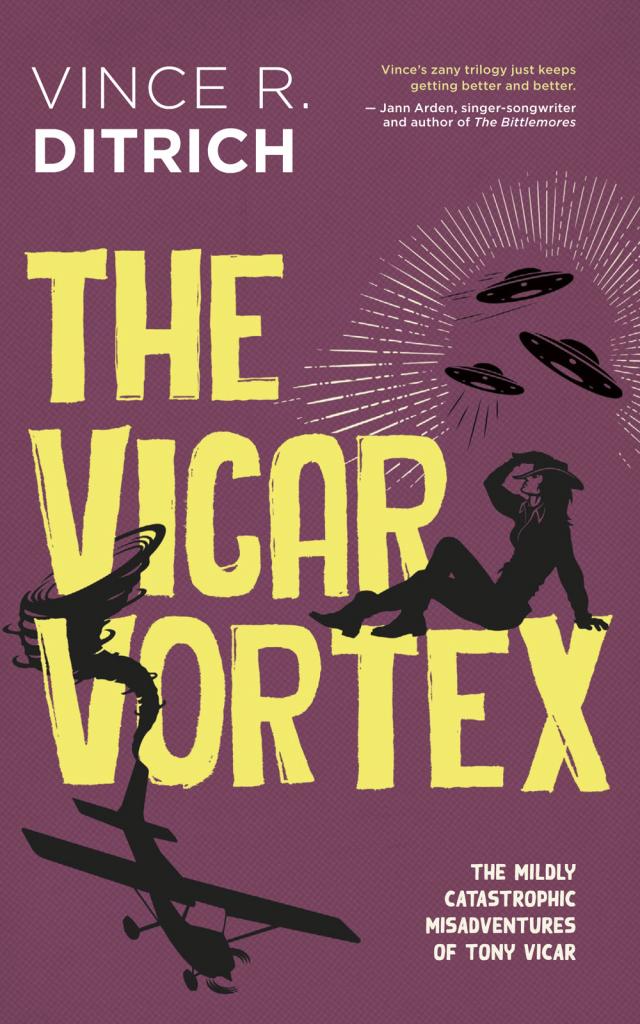
The Vicar Vortex
Copyright © Vince R. Ditrich, 2024
All rights reserved. No part of this publication may be reproduced, stored in a retrieval system, or transmitted in any form or by any means, electronic, mechanical, photocopying, recording, or otherwise (except for brief passages for purpose of review) without the prior permission of Dundurn Press. Permission to photocopy should be requested from Access Copyright.
All characters in this work are fictitious. Any resemblance to real persons, living or dead, is purely coincidental.
Publisher and acquiring editor: Kwame Scott Fraser | Editor: Shannon Whibbs
Cover designer: Laura Boyle
Cover image: cowgirl: 123RF.com/dcart; UFOs: SVGDesigns; Plane: Shutterstock.com/Yaroslav Shkuro; vortex: istock.com/ly86
Library and Archives Canada Cataloguing in Publication
Title: The Vicar vortex / Vince R. Ditrich.
Names: Ditrich, Vince R., 1963- author.
Description: Series statement: The mildly catastrophic misadventures of Tony Vicar ; 3
Identifiers: Canadiana (print) 20230566642 | Canadiana (ebook) 20230566669 | ISBN 9781459747319 (softcover) | ISBN 9781459747333 (EPUB) | ISBN 9781459747326 (PDF)
Classification: LCC PS8607.I87 V52 2024 | DDC C813/.6—dc23
We acknowledge the support of the Canada Council for the Arts and the Ontario Arts Council for our publishing program. We also acknowledge the financial support of the Government of Ontario, through the Ontario Book Publishing Tax Credit and Ontario Creates, and the Government of Canada.
Care has been taken to trace the ownership of copyright material used in this book. The author and the publisher welcome any information enabling them to rectify any references or credits in subsequent editions.
The publisher is not responsible for websites or their content unless they are owned by the publisher.
Printed and bound in Canada.
Dundurn Press
1382 Queen Street East
Toronto, Ontario, Canada M4L 1C9
dundurn.com, @dundurnpress
Dedicated to the Three Musketeers
Who will someday be
Three Wise Men:
Ollie, Sparky, Louis
Prologue / Aftermath
It was a miracle that the entire building hadn’t collapsed into a charred ruin. The southwest corner of the old Agincourt Hotel had been burned to nothing, from third-floor roof down to the ground, and the blaze had devoured both shops at street level, as well as the hotel lobby.
But the Vicar’s Knickers Pub, the town’s centrepiece, located over on the other side of the hotel, still stood and was in surprisingly good shape. The wall that separated pub from hotel lobby was quite heavily fire singed, but other than smoke damage, the rest of the Knickers was standing and in one piece.
For a long time, the entire building was barricaded off, covered by a construction-site fence that blocked the view and left an eyesore in downtown Tyee Lagoon. It took nearly a year and a half to clear the damage and rebuild what was lost.
In the meantime, the stories about Tony Vicar, the entire litany of half truths and rumour that had sprung up before him like a hardened manure ha-ha in a field, heated up to a rolling boil. Several years before, he had become an internet sensation when reports claimed that he had magically brought a dead person back to life at the scene of a car crash. Just like that, Tony Vicar had become famous, although at first his cachet was a bit “niche.” Paranormal, woo-woo, comic-relief spooky bits and such.
Members of the media had set upon him like a pack of hounds, absorbed his girlfriend, Jacquie O, into the narrative, too, and then a couple of them had badly overstepped …
They were real stinkers, those two; muckrakers from Hollywood, deliberately starting a fire in Vicar’s hotel, which instantly became an emergency of dire proportions. Vicar had pulled off an impossible rescue of his foster daughter and another baby, and had reported that he’d had, or at least he thought he’d had, paranormal help doing it. Vicar had been guided through the flames by something unreal. A ghost … Or a hallucination. As to which, Vicar wasn’t sure.
But he’d got the kids out. It was through a blaze that surely should have killed them, but somehow, he made it out with one kid in his arms, the other stuffed into his shirt. Ann Tenna, his best server, who had been working downstairs when the fire started, had also seen the entity. Her confirmation of his experience made Vicar feel a little less alone, a little less “touched.”
After that point, fascination with Vicar and his “magic powers” had no hope of dissipating — long after he was dead and gone, the stories would live on. The tales were exaggerated beyond belief now; Vicar cringed at how they might become full-on nuts after he died and was unable to refute them.
The pair of slimy reporters responsible for the fire had fled back to Hollywood after feeling legal heat coming their way. Truthfully, they more limped than fled … Vicar and company had gotten their pound of flesh and he hoped the villains’ drawn-out attempts at avoiding extradition would someday end in their incarceration. Pretty boys who had done as poorly in Tyee Lagoon as they would face a calamity in prison. Vicar estimated that they both had a purdy mouth, and one was even minus a good number of teeth — surely a boon in the Pen.
* * *
It took a month to remove the fire damage from the remains of the hotel’s innards and another seven months to replace it all. The centre and north framework still held firm in the main, but an entire hunk of the building to the south side had had to be rebuilt. This time the builder was much quicker in finishing the hotel rooms and did a rather imaginative job of overhauling what had been left of the lobby, brand new but artfully treated to look antique. The decorating and furnishing took longer still, but things were in pretty good nick as the two-year mark hovered on the horizon. Vicar and Jacquie had finally retired its original name, “Agincourt,” and dubbed it “Hotel Valentine,” in honour of the day they “took delivery” of their foster daughter, Frankie. She had appeared on their doorstep, from where they did not know.
Valentine was also the name of the ghost that was said to have haunted the old building. If it had ever existed outside Vicar’s imagination at all, the spectre had made itself scarce since. Vicar was afraid that he might need to see a psychiatrist or psychic — maybe both. His interactions with the eerie presence had been terrifyingly real.
After the rebuild, no one had mentioned even the slightest ghostly disturbance, though the internet remained rife with ever-escalating speculation. Vicar resigned himself to it. A hotel with a ghost was free advertising in a very big way, like having goats on the roof.
* * *
At the time of the great fire, some two years before, Vicar was shocked but above all else deeply relieved that he had managed to get baby Frankie and l ittle Wallis out of the third-floor suite alive. As for the rescue efforts by the now wildly famous hotel ghost … If Valentine had only been an illusion, Vicar would never again be able to trust his eyes and ears.
“He,” the ghost, had taken the shape of a young man, who had walked Vicar and the little ones through a roaring, deadly flaming doorway without any ill effects. Jacquie had been certain Vicar had hallucinated the whole rescue, that he had experienced some form of psychosis brought about by ultra-high stress. She had compared it to a ninety-pound woman lifting a car off her child trapped beneath it.
Vicar was left believing Jacquie and his own perceptions at the same time. It was a balancing act that never quite reached equilibrium.
* * *
Inside the Knickers many months later, only the smell of smoke remained, which had dissipated with time.
The place was a marvel, really. Vicar had spent a colossal amount of money dreaming up and building a pub that was nearly cathedral-like, with a thirty-five-foot-tall ceiling, a giant inglenook on one side, stone seating cut into the floor surrounding it, and a gargantuan, lovingly crafted bar. Vicar’s most faithful regulars were presented with small brass plaques attached to the places they preferred to sit, and an instant tradition was born. It was held that, if you were sitting there when they arrived, you surrendered your seat to them. That tradition alone had turned a small handful of regulars into acolytes, some of whom thought of themselves as a guard of honour and treated the Knickers almost like holy ground.
The reopening of the Knickers was a surprisingly celebrated affair, right down to the mayor attending. Vicar hadn’t known that Tyee Lagoon even had a mayor, so the guy could have been bullshitting, but whatever. Hizzoner was drinking red wine, the cheap stuff that tasted like grape juice mixed with violin bow rosin. Vicar had whispered into the ear of one of his regulars, Chief Hank Wheat, “Is that really the mayor?” as he gestured with his eyes toward the tipsy man with the wine-stained dentures. The Chief just shrugged and replied, “Do we even have a mayor?”
However, Condé Nast Traveler sent a writer, as did Vancouver and Victoria papers, all the regional publications, and a voluble and thirsty writer from the Saskatoon Star Phoenix — hometown of the hotel’s ghost, it was claimed. There was also a long lineup of unwanted beggars-on from paranormal websites that had dogged and harried Vicar for years — ever since he was credited with having brought Julie Northrop back to life after the now-famous car wreck on Midden Hill near Tyee Lagoon.
Everyone, everywhere, knew the story — and everyone had their own take on it. Those bizarre “takes,” often printed in huge, jolly lettering, supported the opinion held by some that logic and common sense no longer were in vogue. In fact, the world had gone to shit so badly that people demanded the arcane and magical, or so it seemed. Sheer fluke of timing had hoisted poor Vicar into the stratosphere.
Although the EMT had considered her beyond help, ceased CPR, and called it, Julie Northrop had “come back” after Vicar’s stubborn ministrations. That much of the tale was true, although Vicar wasn’t sure why she had come back. But then paranormal cyber-sleuths had grabbed hold of the story, and it had exploded like a pile of gasoline-soaked autumn leaves. Because of the nature of modern news dissemination, there could be no healthy skepticism about the story. Vicar was, obviously, magic. He obviously brought people back from the dead. There could be no other possible explanation. Duh, you guys …
Overpaid movie actors, eagerly watched by fully grown adults in their multitudes, sported tight-fitting leotards, saved the world, and defied physics on a discouragingly regular basis. Somehow, while their heroes hovered, flew, lifted locomotives, and blew up shit with their laser-beam eyeballs, normal folks watched these laughable protagonists with straight faces, and still ended up in the hospital, fallen and fractured, from catching their toe on the doormat. This glaring dissonance was never fully investigated. Vicar knew this phenomenon all too well.
His life had made such a sharp turn in the last few years that he had begun to wonder who he really was. Between the chasm of what he had experienced, what public opinion claimed, and what made sense, lay his story.
One / More or Less than Meets the Eye
The view from that high was tremendous. To Tony Vicar’s right, he saw the Strait of Georgia, a dark bluish-purple, laid out beneath him in mosaic-like cells, the tideline a margin where colour changed dramatically to a milky aqua green. To his left stood the Beaufort mountain range, imposing, snowcapped, and gleaming in the sun, crowned by clouds that looked like a nicely stiff meringue, brilliant white, a little grey where cloud met mountaintop, and with a base of royal blue. When the sun angle was right, he could even catch a glow of pink tinging the high plumes.
The Merchants’ Association of Tyee Lagoon — a tiny, miserly group that sounded much grander than it was — had offered Vicar a free flight in Gunnar Bering’s Cessna, in reward for his generosity to the locals: a sightseeing joyride around the gorgeous environs surrounding his hometown. They had had to spring for the fuel, nothing more; even so, there had been some hushed grumbling.
Vicar let a great number of folks hold their club and team meetings in the Vicar’s Knickers, on a regular basis, for no fee. Winters here on Vancouver Island were very slow, so getting a few bodies into the pub made a big difference to his bottom line. He had invested in “velvet ropes,” which did nothing more than surround little areas within the pub for their events with an uppity-looking, glorified snow-fence. Really it was as pointless as a non-smoking section in a jetliner, but people thought it looked legit and treated those ropes like they were an impenetrable barrier through which non-members might not trespass, nor even listen.
The local Book Club held its monthly meeting there, but that event was a loss because they were all prim teetotalers and brought their own snacks. Vicar could have kicked about that but didn’t; they were almost all old ladies and he had a soft spot, even when a couple of them acted supercilious and lofty, bitching about spelling and punctuation on the menu. For a couple of years, Ann Tenna and Beaner Weens, the cook, had been in a low-grade war over authorship of the accursed and often indecipherable chalkboard. They both tended to communicate like trick dogs that use talking foot pedals. Vicar had given up refereeing when he realized how stultifying their arguments had become. The near-brawl that had erupted over the spelling of “Cosmopolitan” was one for the ages. Kosmopulletin, Cosmapahlitain, Kusmoballintun … He’d listened, baffled, his head twisted sideways like a foot-pedal pup.
The sporadically charming Book Club ladies held a raffle every meeting and the prize was usually something knitted or crocheted, and invariably non-essential. Occasionally they made pottery. One of the oblivious ol’ gals had actually made and donated a white ceramic elephant statuette. Vicar had snorted audibly and one of their membership glowered at him.
Realizing that the glaring metaphor was invisible to most of these women, Vicar had coughed up a loonie, placing the coin respectfully on the raffle table — just to make nice — and won an oven mitt, made of Phentex or some other ghastly flame accelerant, that instantly snagged a fingernail when he tried it on. The sensation was extraordinarily grating; he’d waited until they departed and thrown it in the trash.
He had found a comfy wingback chair for Mrs. Oliver, one of the nicer ladies, a long-retired school librarian who attended the Book Club’s monthly gatherings religiously. He set her chair nearer the ladies’ room, at her request, right next to her companion, Mrs. Parker, with space nearby to stow her walker, where it could sit unobtrusively. As customers, Book Clubbers were el cheapo grande: long-retired millionaires mostly, but tight enough to squeak. A few even brought their own tea bags and just ordered hot water, but Vicar got a good snicker from his new “walker parking” area and the ten-dollar honorarium they always bestowed upon him, presented with desultory golf claps, slipped into a dollar-store thank-you card.






