

Marion lane and the dead.., p.1
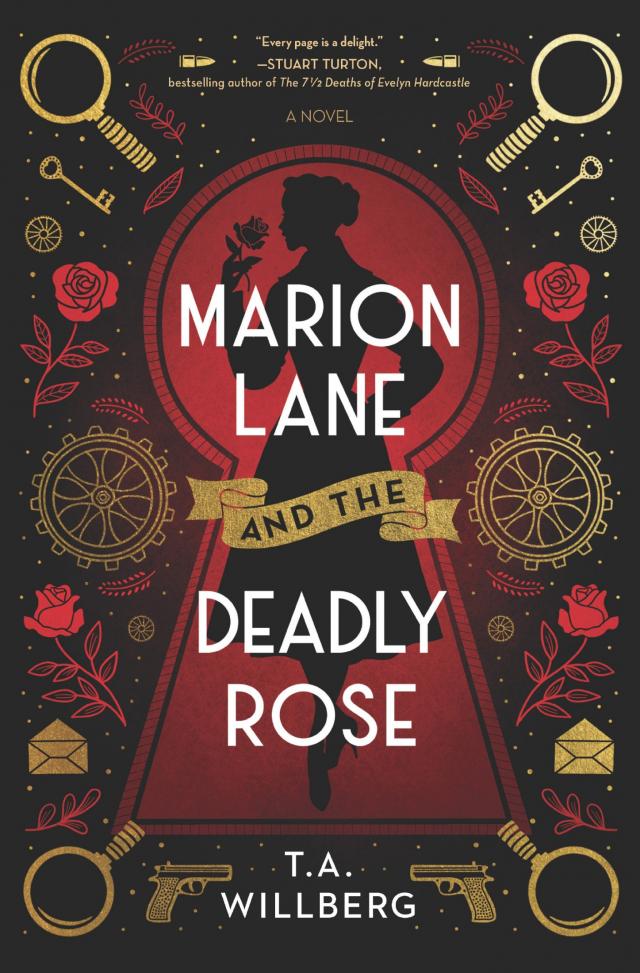
Marion Lane and the Deadly Rose, page 1


Praise for Marion Lane and the Midnight Murder
“The worldbuilding is wonderful and the mystery got its hooks into me from the first chapter. This is what would happen if a trainee James Bond was asked to solve an Agatha Christie mystery, and it’s brilliant.”
—Stuart Turton, bestselling author of The 71/2 Deaths of Evelyn Hardcastle
“Marion Lane and the Midnight Murder crackles with invention and surprise—the wondrous gadgetry, the moody settings, the endearing heroine and the struggles she’s endured—and Willberg weaves it all together around a perfectly puzzling locked-room whodunnit.”
—Matthew Sullivan, author of Midnight at the Bright Ideas Bookstore
“A delightfully stylish romp through London’s foggy streets and secret tunnels, complete with a tantalizing, steampunk-flavored mystery. Willberg has conjured a sharp-witted and sympathetic heroine, a worthy match for the sinister forces and shadowy organizations arrayed against her. Delicious fun!”
—Helene Wecker, New York Times bestselling author of The Golem and the Jinni
Also by T.A. Willberg
Marion Lane and the Midnight Murder
MARION LANE AND THE DEADLY ROSE
T.A. WILLBERG
T.A. Willberg was born in Johannesburg, South Africa, and grew up on a smallholding outside Durban surrounded by horses, sheep, chickens, and more snakes and spiders than she cares to recall. She currently lives with her partner in Malta, where she divides her time between chiropractic and writing. Marion Lane and the Deadly Rose is her second novel.
TAWillberg.com
For Willie
Contents
Chapter 1
Chapter 2
Chapter 3
Chapter 4
Chapter 5
Chapter 6
Chapter 7
Chapter 8
Chapter 9
Chapter 10
Chapter 11
Chapter 12
Chapter 13
Chapter 14
Chapter 15
Chapter 16
Chapter 17
Chapter 18
Chapter 19
Chapter 20
Chapter 21
Chapter 22
Chapter 23
Chapter 24
Chapter 25
Epilogue
Acknowledgments
1
RENDEZVOUS
January 30, 1959
Harrogate, England
Fraser Henley had fought against a blustering gale to arrive at the rendezvous point just in time. His fingers and toes were numb, flakes of snow melted on his coat sleeves, his shoulders, his neck. Everywhere. If it weren’t that this meeting, and the opportunity it presented, was his only hope of living to see his twenty-eighth birthday, he certainly wouldn’t have bothered.
He approached the entrance to the Old Bell Tavern, across the street from the pump room in Harrogate’s center. Heat and golden light throbbed through the pub’s windows. The sweet scent of ale filled the chilled air, for a moment drawing him back to the quiet, peaceful days of his former life, before he became entangled in the dark, sticky world of deceit and double-crossings and debts that must be repaid.
He checked his watch—five minutes past one in the morning. His contact was late, which was not a particularly comforting thought. He dug around in his coat pocket, pulling out a small chrome cigarette case and lighter. He didn’t smoke, but a lit cigarette was his signal, a part of the plan. And if there was one thing he’d come to learn about this wretched organization to which he was chained, it was: you never strayed from the plan.
He lit up and took a long drag, exhaled the smoke into the icy air and peered warily at the street ahead. A part of him now hoped that his contact would not arrive at all. That way, Fraser would have a perfectly credible excuse to turn around and make a run for it. It certainly wouldn’t be the first time he’d tried.
But where could he go?
He felt the wind cut through his coat, the cold sting his eyes. Everywhere he turned, he saw the edge of a coattail slip behind a wall, a figure pull back from a windowsill. He heard their whispers on the breeze, felt their presence watching him always.
Wherever he ran, they would follow.
A shiver swept through him, rattling his teeth. He looked up and noticed something ghostly materialize at the top of the street—a stooped figure shifting from the darkness, moving swiftly toward him as though part of the wind itself.
Fraser’s heart rate piqued as the figure slipped in and out of sight between the sheets of fog. But seconds later, it was right there in front of him: an elderly man, dressed in a dark gray trench coat down to his ankles, a checkered felt hat, a suitcase and polished ebony cane. He had a haggard appearance, deep furrows crisscrossing his brow. The muscles on the right side of his face were atrophied, giving him a permanent and threatening scowl. But even without this distinctive feature, Fraser would have recognized him anywhere—the man of his nightmares, the master of death.
He took a reflexive step backward, recalling tales of the old man’s past, rumors of his malice. He collected himself, realizing that any hint of trepidation would not be met with kindness or understanding. He inhaled a quick, calming breath and spoke the line he’d practiced ad nauseam the past few days. “Fine weather for a smoke, eh?”
The old man frowned, turned his eyes skyward. The snow was falling faster and thicker than ever—vast sheets of it now layering the footway like powdered sugar. “Isn’t it just?” he said with a grin, answering the secret signal. His English was clean, save for a hint of an accent.
They stared at each other knowingly, muted exchanges passing between them. Fraser knew he was only in this situation because he’d already made one stupid mistake, already deceived his deceiver, overplayed his hand. And in turn, the old man knew Fraser would do anything for a chance at redemption.
“Fancy a chat?” the old man suggested, grinning maniacally. He turned around, calling out over his shoulder, “Come along, follow me.”
Fraser hesitated, but only for a moment. It wasn’t a request and he knew it.
The pair made its way around the back of the pub and into a narrow street lined with garbage bins and scraps of waste. It was dark and mostly quiet, save for the hum of mixed voices from the pub and a peculiar mewling sound coming from somewhere near a large dumpster less than a yard off.
“By God!” Fraser said, unable to stop himself as he caught sight of the battered, nearly unrecognizable figure lying on the pavement to the left of the dumpster. He jerked forward, but the old man held out his cane, blocking the way.
“Now, now, careful, young man, or you might end up the same.”
Fraser stopped, swayed on his feet. He was numb again, though not from the cold this time. “Wh-what’s going on?”
The old man pulled a crisp white handkerchief from his breast pocket and began polishing the head of his cane. “I thought that might be obvious?” He fixed Fraser with those awful dark and harrowing eyes. “We know what you did, you and your witless friend over there.” He gestured casually to the crumpled form, which was now writhing and burbling, spluttering blood. “You thought we wouldn’t find out? You actually believed you could run away?”
“No,” Fraser blurted out, a reflex. He didn’t like to think of himself as a coward, but he realized now, he’d do anything to save himself, including betray his closest ally. “It wasn’t my idea,” he lied, glancing again at the body near the dumpster. It was moving, squirming, barely alive. How long had he been kept like this, half-conscious, in hopeless agony? And in those hours of pain and torment, what secrets had he revealed? “I told him it was a stupid thing to do. I told him not to.” He turned back to the old man, unable to look his friend in the eye as he embellished the lie. “I was going to turn him in. I just needed time to come up with a way—”
The old man interrupted. “You were out of contact for five days. Did you not think that might look suspicious?”
“I wasn’t thinking straight. Everything happened so fast.” He breathed long and deep, drawing out whatever strength he had left. “But I’m here now.”
The old man tapped his cane twice against the ground, a signal Fraser didn’t understand. “Does that mean you’re still one of us, then?”
Fraser didn’t falter this time. He was either one of them or he was dead. Easy choice. “Of course.” He shifted his gaze to the left. Even in the alleyway’s pale light, he could see the tapestry of contusions and swellings sprawled across his colleague’s arms and legs. By God...even his face. But it was the distinctive mark singed into the left side of his chest that cemented Fraser’s fear: a rose, pressed deep into the flesh with a branding iron, the old man’s hallmark.
He looked away, unable to stomach it.
The old man, apparently satisfied that his message had been received, extracted a small leather satchel from his suitcase. “Well, I’m very pleased to hear that. And I don’t want you to worry, young man. There’s no need for you to suffer the same fate as your colleague. So long as you do as you’re told. And do it well, of course.”
Fraser took the satchel, extracted a file. He flipped it open, pages fluttered in the wind, dislodging a letter held loose inside: an invitation printed on buttercr
“Everything is already set up,” the old man said, grinning still, a ghastly lopsided expression that turned Fraser’s stomach once more. “All you need to do is transform yourself into someone else, as you’ve done many times before. Take up this young man’s identity, cast aside your own.”
Fraser ran his thumb over the photograph. Indeed, the face staring back at him was his own. But the eyes were cold and vacant, as though the soul inside had withered. And it would only get worse with time, he knew. Another metamorphosis, another untruth, another piece of his character stripped away, replaced with something alien.
He swallowed back the lump in his throat, folded the photograph and slipped it into his coat pocket. “The application has been approved, I presume?” He’d been warned many months ago that this stage of the mission might be necessary, the hardest part, the most dangerous part. Only, he’d hoped to have vanished by then.
The old man, who’d been watching him with flickering eyes, now said, “Partially. The final step is up to you. An interview. All you need to know for the time being is inside the file. The rest I shall explain as soon as we’ve established a reliable system of communication. Now,” he added with a note of misplaced levity, “there’s a train to London early tomorrow morning. You and I will be on it.”
Fraser decided not to ask any further questions. Frankly, the less he knew right then, the better. He forced his eyes to meet the old man’s, who was still smiling at him with the air of someone awaiting his moment to deliver the punch line of some hideous joke.
“Simple enough, isn’t it?”
“Yes,” Fraser answered with thinly veiled horror.
The old man clapped his hands together merrily. “Wonderful, wonderful!”
Fraser turned back to the crumpled form beside the dumpster, bile rising in his throat as he allowed his brain to accept what his eyes were seeing—his once vibrant, healthy friend, now nothing more than a bag of crushed bones. “What about—?”
“Ah, I’m glad you asked.” The old man leaned over his cane and extracted something else from his suitcase. A Makarov pistol, Fraser realized with a start. “Consider this your first...trial.” He handed Fraser the weapon.
In that moment, it was as if every thought in Fraser’s head disappeared, clearing space for the only thing he needed to think about. He knew perfectly well what the old man was asking him to do, and he knew just as well what would happen if he didn’t do it. He looked at Eddie—his colleague, his friend, the man he’d spent six years training with, on assignments with, drinking and dancing and taking out girls. Those years had been such an adventure, even though in the back of their minds they’d both known that one day it might come to this. They’d played with fire and now one of them had to burn.
“Your life or his,” the old man whispered, barely loud enough to hear above the swirling wind and the low drone of music drifting out from the pub’s back window.
Fraser closed his eyes for a brief moment. He wished he were someplace else, in Prague with Eddie, back at home with his mom, at the bottom of the Thames, anywhere but here. He wished he could rewind the past six years, go back to the start and chose a different path. But underneath all that there was also something dark and vile cowering inside him. Something that reminded him why he was here in the first place. Self-preservation.
Your life or his.
He opened his eyes. The snowfall was lighter now, the wind softer, dawn was coming—a new start, his only hope. He might be a coward, but he was a survivor, too.
He looked at Eddie—his swollen, bloodstained face fixed in an expression of agony, his mouth parted slightly, eyes wide and staring. The rose branding on his chest, testament of his betrayal, stark against his pale skin.
“You’d have done the same,” Fraser said as he pulled the trigger.
2
A DARK DAY DAWNS
February 9, 1959
Fulham, London
Despite the fact that it was well past ten o’clock on a Thursday evening, the normally quiet and lifeless atmosphere of the Filing Department at Miss Brickett’s Investigations and Inquiries was bustling more than it had in nearly a decade.
Here, concealed within a vast subterranean network of convoluted passageways, workstations, training chambers and grand halls, lay the “post office” of Miss Brickett’s, the clandestine private detective agency that served the City of London in a way no other could. Jutting out from the department’s eastern facing wall were the termini of hundreds of pneumatic tubes that climbed like tentacles upward through miles of rock and brick to reach concealed postboxes dotted across London, through which Miss Brickett’s received case requests and tip-offs.
Now, as the alert light blinked and its bell chimed, a letter appeared from one of the tubes and was collected, documented and sorted according to its contents. The Filing Department, on average, received around ten letters a week from the citizens of London—those who knew of the Inquirers’ existence and location of the secret postboxes. But tonight alone, the agency had been overwhelmed with nearly two hundred hastily scribbled pleas for help. The requests had started pouring in around 5:00 p.m., just as Marion Lane, a second-year apprentice detective, had finished up her training duties and settled in the library bar with her colleague and best friend, foppishly handsome Bill Hobb. Marion adored Bill for uncountable reasons but principally for his ceaseless inclination to protect her from physical strain or emotional turmoil. As if to affirm this once again, he pulled out a rickety barstool and steadied it as she climbed up, before hauling her overfilled haversack onto the counter (wincing with the effort). Bless him. But despite her build—flimsy as a willow branch—she was slightly more proficient at heavy lifting than Bill, though she’d never tell him so.
Unfortunately, they’d not managed even a sip of their selected drinks (wine for Marion, a pint of ale for Bill) before they were accosted by a short, robust lass with cropped hair, dressed in ill-fitting trousers rolled up to the ankles and a loose blouse. Maud Finkle burst into the bar, poured herself a whiskey and announced, “I need help.”
Only because she looked as if she was about to have a fit, Marion and Bill agreed to follow her through the library and down a set of stairs into the Filing Department.
“Blimey, what’s going on here?” Bill asked, rolling up his sleeves in preparation as he noted the sky-high piles of unsorted letters scattered across the department floor. Bill was just the sort of person you’d call on in a crisis—quick-witted and invariably rational, always ready to help, albeit with a grunt and the occasional eye roll.
Maud, normally utterly unflappable and indifferent, pointed to the ceiling and declared, “The weather.”
Bill frowned, moving a hand through his dark hair. He passed Marion a questioning glance, who offered him a shrug.
Eventually, Maud elaborated. “Thick fog, a real pea-souper. Zero visibility around London, jams everywhere.” She pressed a thumb into her eye. “At least six people have already been injured in collisions. And there’s looting of course, and people struggling to get home. And since our sodding filing assistant decided February’s a good month to take his annual leave, I’ve been stationed here all alone! The Met Office say it’s already worse than the first day of the Great Smog.” She took a much-needed breath, tightened the belt of her cropped trousers (which were in no way compliant with the official agency uniform for women—grayscale pencil skirt and blouse—not that she ever seemed to care).
“Worse than the Great Smog?” Bill asked incredulously. “You sure?” The weather outside, whatever it happened to be, was generally of little concern to the employees of Miss Brickett’s, sheltered below the earth in a perpetually sunless world.






