

Never trust a partner, p.1
Never Trust a Partner, page 1


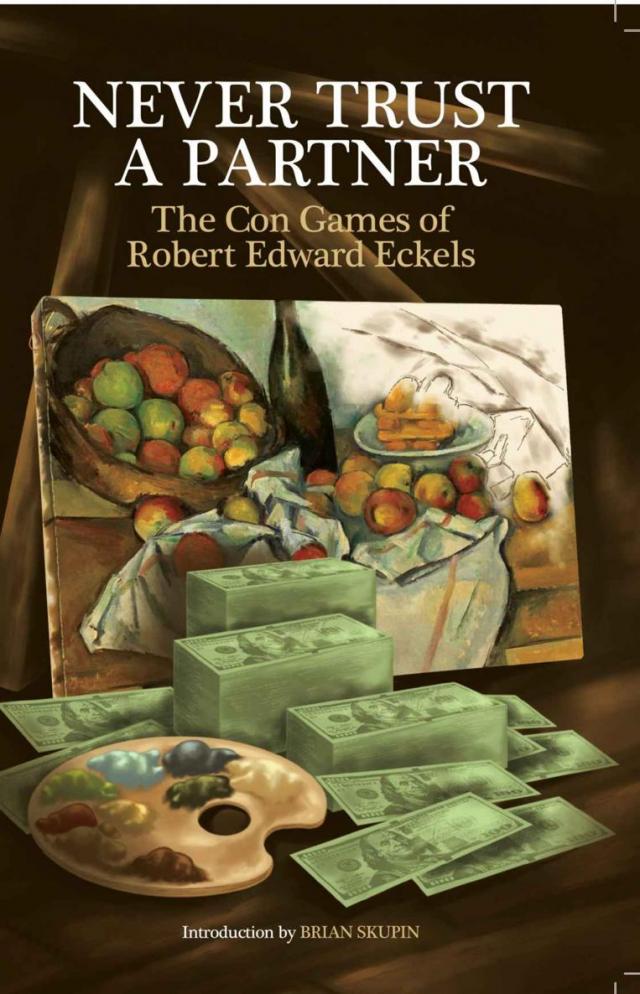
Never Trust a Partner
By Robert Edward Eckels
Copyright 1969, 1970, 1971, 1972, 1974, 1977, 1978, 1982, 1986
All other materials copyright © 2021 by Robert Edward Eckels. All characters in this publication are fictitious and any resemblance to real persons, living or dead, is purely coincidental.
All rights reserved.
No part of this publication may be reproduced, stored in a retrieval system, or transmitted, in any form or by any means, without the prior permission in writing of the publisher, nor be otherwise circulated in any form of binding or cover other than that in which it is published and without a similar condition including this condition being imposed on the subsequent purchaser.
For information contact: Crippen & Landru, Publishers P. O. Box 532057
Cincinnati, OH 45253 USA
Web: www.crippenlandru.com E-mail: info@crippenlandru.com
Jeffrey Marks: Publisher Douglas Greene: Senior Editor
ISBN (softcover): 978-1-936363-54-4
ISBN (clothbound): 978-1-936363-55-1
First Edition: June 2021
Contents
ContentsContents
Introduction: Confounding Expectations
Sources
A Question of Honor
Only Bet on a Sure Thing
The Waldemeer Triptych
Never Trust a Partner
The Kidnaped Painting
Hobson’s Choice
The Switcheroo
Lang and Lovell Go Legit
Quit When You’re Ahead
The Canadian Caper
The Bellman Portrait
Bread Upon the Waters
Nobody Can Win ’Em All
The Long Arm of the Law
Sufficient Unto the Day
Never Play Another Man’s Game
Bibliography
Introduction: Confounding Expectations
By Brian Skupin
rom the end of the 1960’s to the late 1980’s, Ellery Queen’s Mystery Magazine (EQMM) and other magazines published a remarkable run of stories written by Robert Edward Eckels. They included a wide range of subjects: bank robbery, domestic suspicion leading to murder, ordinary men caught up in extraordinary circumstances; smuggling, kidnapping gone wrong, and large-scale manhunts.
F
But the majority of them of them showed Eckels excelling at two related types: stories of confidence men, and the world of spies crossing and double-crossing each other. The structure inherent in each marks both a strength—the appeal to detective story fans who enjoy plot twists or reversals—and a weakness—the very nature of the form foreshadows the surprise, lessening its impact.
Yet for 20 years Eckels was able to surprise again and again, repeatedly designing dazzling new variations on the swindle. Most of his stories were standalones, but he wrote two popular series, both of which are collected here in their entirety: The Lang & Lovell art forgery stories and the tales of Major Henry T. McDonlevy, the “world’s greatest adjutant.”
Eckels’ second published story, “The Blue Lady” in the October 1969 issue of EQMM was the beginning of a series of tales about Lang & Lovell. Lovell is the inside man, the forger who can reproduce any painting by any artist living or dead, but who is so nervous that he “jumps around like a bean on a string.” Harry Lang is the breezy, confident outside man who knows how to find wealthy buyers and how to push their buttons to make a profit.
Here it would seem that the even-more-constrained formula would make it too difficult to tell repeated stories, let alone a series of twelve is even more constrained than one would think the format is too constrained to be repeated. In each story we know that Lovell will forge or already has forged a painting, and that somehow Lang will perpetrate a scam for money. But Eckels time and again found a new trick and was able to surprise readers with the solution.
All the Lang & Lovell stories are briskly told, largely in dialogue, and are compulsively readable. The reader gets a little bit of inside information about the art business or forgery techniques, and roots for Harry to make his score while wondering how he can pull it off. There are some delightful grace notes in the writing that set them apart from the average magazine stories of the time: note the byplay Harry Lang engages in with receptionists—he is forever trying to get past receptionists—a moment in “The Blue Lady when “cupidity and caution battled to a standstill” behind a mark’s eyes, or the reason for Lovell’s indignation at the end of “Only Bet on a Sure Thing.”
The stories do not need to be read in sequence, although there is a character in “The Waldemeer Triptych who reappears in both “The Kidnaped Painting” and “The Canadian Caper.” Perhaps the best L&L stories are “The Kidnaped Painting” which packs an immense amount of plot into six pages, and “Quit When You’re Ahead,” with its cat-and-mouse game and interesting sidelights on art auctions. “Never Trust a Partner” was included in the Best Mysteries of the Year—1973, edited by Allen J. Hubin and published by Dutton.
The five Major Henry T. McDonlevy stories included here are something else again. The Major is an old school rogue, amiable and intelligent, always interested in a proposition bet or a night of poker. He refers to himself as the “world’s greatest adjutant,” an Army adjutant being an officer performing executive duties as needed for the commanding officer. Eckels explains this was an inside reference from his own service: “I once overheard the officer I worked for—and whose physical description I used for the Major—jokingly use this phrase about himself in a conversation with a fellow officer. The Major, however, isn’t joking.”
McDonlevy’s partner and the first-person narrator of the stories is Tom James, who we meet in jail for disorderly conduct at the beginning of the first story, “Bread Upon the Waters,” when the Major frees him by paying his fine. But Tom’s role is different from Harry Lang’s. He’s the equivalent of a three-card monte man’s shill, lending substance and believability to the Major’s game. The cons are more substantial, and the stories reflect that in length and complexity.
The Major McDonlevy stories are all outstanding but “Bread on the Waters” is clearly the best. It’s also Eckels’ favorite of his stories, and he reports that according to Eleanor Sullivan, editor of EQMM at the time, “Fred Dannay said it was the best story he’d read in years.” The ending seems to come out of nowhere, and yet the groundwork has all been laid in advance. Eckels says: “If you parse it, you see that it follows the classic strong magazine plot line to a tee.”
Robert Edward Eckels was born December 7, 1930 in Christian Welfare Hospital in East St. Louis, Illinois, a descendant of Scots who immigrated to Ireland in the 1600’s and then later in the 1700’s to America. His father, Wilbur Rivers Eckels had been born in Kentucky but at a young age his father, a railroad worker, moved the family to East St. Louis, Illinois. Wilbur also worked for the railroad his entire career. In 1929, he married Dorothy Robert Beardsmore, a typist in a business office.
Wilbur had hoped his son Robert Eckels would attend the United States Naval Academy in Annapolis, Maryland, but by an early age Eckels’ poor eyesight ruled that out. Eckels decided that since he liked to read, he would be a writer.
In Grade 7, Eckels borrowed the Complete Sherlock Holmes by Arthur Conan Doyle from the library, and over time checked it out to read repeatedly. Eventually his mother allowed him to spend $2.49 on his own copy, which he still has today. Other favorite writers included Agatha Christie, Erle Stanley Gardner, John Dickson Carr, Ellery Queen, and, notably, O. Henry, in particular the “Gentle Grafter” con man stories featuring the Old West swindlers Jeff Peters and Andy Tucker.
Later, in high school, Eckels borrowed a copy of EQMM from a teacher. Inspired, he wrote a mystery and submitted it. It came back rejected and Eckels was upset because “they sent back a subscription offer with the rejection, which said to me that they really didn’t consider me a serious author.”
Eckels persisted. In college he wrote a short story for a class assignment and submitted that for publication: “They rejected it and, this time, they didn’t send me a subscription offer so I figured I had stepped up. “ After graduating from the University of Illinois, Eckels volunteered for the Army and attended Basic Training at Fort Leonard Wood Missouri. Eckels trained to be an engineer but found he was inconveniently sized: “Big enough to be placed in the 1st platoon which did all the heavy work, but small enough to be one of the smallest men in the platoon.”
After Basic, Eckels was posted to Germany where it was discovered he could type, and he became a headquarters trooper. Eckels had taken typing, along with algebra, as an elective in school: “I’ve long forgotten most of the algebra, but typing has remained one of the most useful things I learned in 17 years of education.”
Eckels left active military service in 1955, and left Reserve duty as a Sergeant First Class in 1961. The U.S. Social Security Administration (SSA) was hiring. It was doing work he believed in: “Its intent from the beginning has been to insure that old age or disability did not entail dependency on others or a descent into poverty, and that young widows with children would be able to keep their families together. Who couldn’t believe in a program like that?”
Eckels passed the Civil Service examination and became a claims representative. For a young man ready to relocate as needed, the SSA offered tremendous opportunity for promotion, and Eckels took full advantage, moving several times and advancing hi s career.
The moves had another benefit. During a stint in Baltimore, Maryland, Eckels noticed the name Margaret Heindel on an office list, and remembered having met her during an earlier posting in Battle Creek, Michigan. He contacted her and they married less than a year later. They would have two sons: Thomas Robert and James Edward.
Eckels made another rediscovery in Baltimore, where he saw EQMM again on the newsstands and finally subscribed.
At around the same time, while sorting through belongings after his father Wilbur died in 1966, Eckels found some of the short stories he’d written, and started thinking about writing again. “I was reading a mystery which had a pretty tired plot. I came up with a variation that I thought would be better.” Eckels submitted it to an agent along with a $5 fee. “I got it back with a really long letter from one of his staff that said ‘I’m sorry, this story really has no merit.’”
But Margaret didn’t agree, saying it was “as good as anything I’ve read in a magazine.” So with his wife’s encouragement Eckels submitted it to EQMM. “The Man in the Revolving Door” was published as the 329th First Story in the October 1969 EQMM, and Fredric Dannay, writing in the headnotes as Ellery Queen, called it “an extremely smooth and unusually entertaining story for a ‘first’.”
Now the stories came tumbling out of Eckels’ typewriter. The first Lang & Lovell story was published in 1970, and by the end of 1972 22 of his stories had appeared in the magazine, three of them under a pseudonym—“E.E. Roberts”—at Dannay’s suggestion. When asked how he produced so quickly Eckels replies, “Damned if I know. Plots just seemed to be there just waiting to be picked up.”
“Bread Upon the Waters” appeared in 1973, and although the pace inevitably slowed Eckels wrote and sold a total of 55 stories through 1986, 45 of them to EQMM. Margaret proofread the stories before submission—except one. “He wrote one about a little boy who was kidnapped (“A Little Ride in the Car”). And I refused to proofread that story because I thought of our boys.”
Eckels notes that Dannay was very hands on with EQMM. After two acceptances, Eckels’ third story was rejected, with a handwritten note. “The last line read ‘If you have any questions, call me,’ with Fred’s phone number. I called and he spent a long time explaining why this particular story didn’t work out. I think the purpose was to tell me not to let this rejection stop me from writing. And it didn’t.”
Eckels participated enthusiastically in the mystery community. He joined the Mystery Writers of America (MWA), was President of the Chicago chapter, joined the Chicago Sherlockian society Hugo’s Companions, and attended conventions. He recalls being impressed by Mickey Spillane at the 1981 Bouchercon: “I did pick up a lot of respect for Mickey... He showed himself to be a thorough professional who knew exactly what he was doing: putting comic book plots into adult novels.”
Several of Eckels’ stories have been reprinted in anthologies over the years, but there has been no collection as such. In 1989 Castle Books published Tales of Espionage, edited by Chris Dorbandt and EQMM’s Eleanor Sullivan, which featured the stories of Eckels, Edward D. Hoch, and Brian Garfield. It includes eight of Eckels’ CIA stories, fashioned into a “series” by grouping the unnamed agent protagonists as “Anonymous Men of the CIA.” Eckels found out about the collection “when they sent me a copy of the book.” (Note that because EQMM at the time purchased first anthology rights they would have already owned the rights to publish the stories in a collection.)
Since the September, 1986 publication of “The Bellman Portrait,” the last Lang & Lovell story, there have been no new stories by Eckels. He explains why:
“I ran out of plots. When you come right down to it, all con games are essentially the same; so the number of variations you can use is limited. I talked to Ed Hoch about this and he agreed, having a con game series of his own. I didn’t want to mechanically write the same story over and over with only the characters and setting changed; so I stopped.”
As a present for his 90th birthday in 2020, his son Jim Eckels decided it make sure that Eckels’ grandchildren understood his literary achievement, and arranged for Evan Eckels to build a website listing and commemorating his work, and for Alyssa Eckels to conduct an interview which was posted there.
At the same time, this collection was being discussed and prepared, and as part of the enterprise Eckels wrote a new Major McDonlevy story*.
Against the odds Eckels has now started writing again. “Once I started I found it hard to stop. I have finished a second McDonlevy story. And I’m currently working on a non-series story.”
And so, after 35 years Eckels has once again found a way to surprise readers.
We hope you enjoy the stories.
* “Major McDonlevy Does the Math” was published in 2021 as a pamphlet included with the clothbound edition of this collection.
Sources
Emails exchanged between Robert Edward Eckels and Brian Skupin, January–February 2021
The website www.roberteckels.com by Evan Eckels
Interview with Robert Edward Eckels conducted by Alyssa Eckels and published at www.roberteckels.com
Tales of Espionage, Edited by Eleanor Sullivan and Chris Dorbandt, Castle Books, 1989
The Blue Lady
Lovell was waiting for me in the park across from Carter’s mansion. As I walked up the path I could see him fidgeting on the bench.
If he’d been a less sedentary man he would have been pacing back and forth. If he’d been less of a health nut he’d have been on his second pack of cigarettes. That’s how nervous he was.
“You’re late,” he said accusingly as I came up to him.
“Only fourteen minutes,” I said. “That counts almost as being on time.”
“That’s easy to say, but now you’ll be late seeing Carter.”
I sat down on the bench beside him. “How can I be late when he doesn’t know I’m coming?” Nodding toward the package he clutched in his lap I said, “Is that the painting? Let me have it and I’ll beard Mr. Carter in his lair.”
Lovell let go of the painting with one hand and clamped onto my arm. “Maybe we shouldn’t go through with this, Harry.”
“Don’t be silly,” I said. I pried his fingers loose and flicked my own across my sleeve to smooth out the creases. “Of course we’re going to go through with it. If that painting is half as good as you say it is, Carter might as well start counting out the money right now.”
I took the painting from him and hefted it in my hands. It was surprisingly light; most of the bulk came from the wrapping. The picture itself was perhaps a foot and a half high by a foot wide. “Van Diemen’s The Blue Woman,” I said, “and our key to fortune.”
“The Blue LADY,” Lovell corrected. “And it’s good all right.” The quality of his work was the one thing you couldn’t shake Lovell on. “Van Diemen himself couldn’t tell this one from the one he painted two hundred years ago.”
“Then there’s nothing to worry about,” I said and left him still fretting on the bench.
I walked up the curving white gravel driveway to Carter’s front door. Arriving by car would have been classier, but cars have license plates and can be traced. Not particularly wanting to be traced, I walked.
There was a fancy bell-pull arrangement beside the door. I ignored it and rapped with my knuckles. A few minutes and several raps later, the door swung open and a girl in a black and white maid’s uniform gazed at me out of dark, liquid eyes.
“Yes?” she said.
“My name is Lang,” I said. “I’ve come to see Mr. Carter.”
“I don’t know,” the girl said doubtfully. “Mr. Carter is very busy—” Her voice trailed off indecisively. She spoke with a heavy accent— German, I supposed. And from the way she acted she hadn’t been in this country very long—at least, not long enough to lose her awe of Americans or to acquire the arrogant attitude that most rich men’s servants display to their masters’ supposed social inferiors.
Nevertheless, she wasn’t going to let me in. But I’d expected that. “Tell him it’s about The Blue Lady,” I said. When she still hesitated






