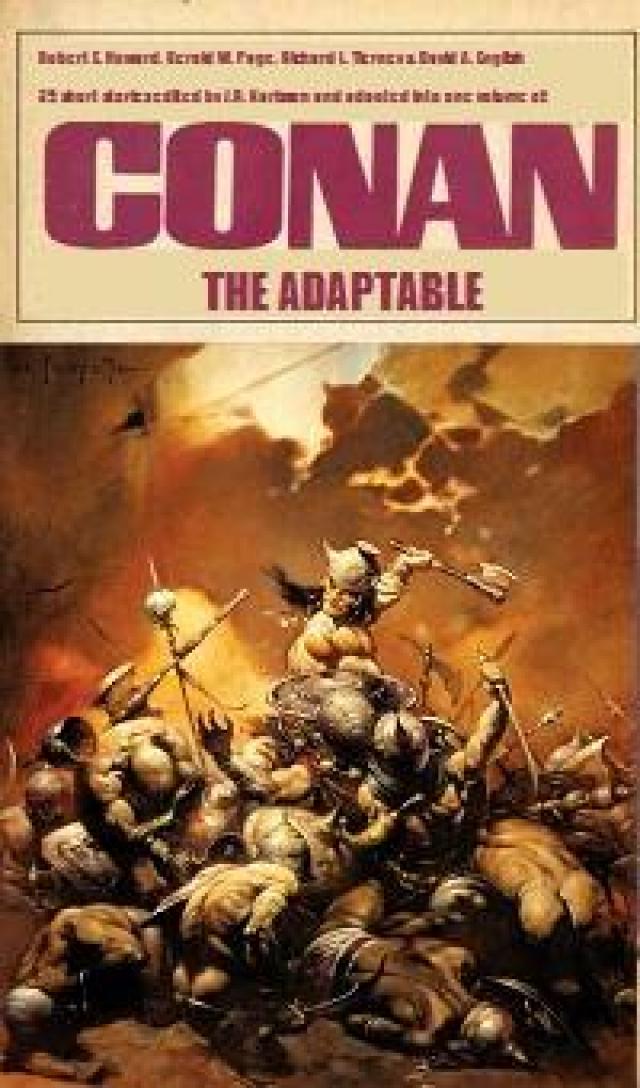
Conan the adaptable, p.66
Conan the Adaptable, page 66


“You mean to follow that fiend into that black tunnel?” ejaculated Wakim aghast.
“Why not? We’ve got to follow and kill him anyway. If we run into a nest of them – well, we’ve got to die some time, and if we wait here much longer they will be cutting our throats. This is a chance to get away, I believe. But we won’t go in the dark.”
Hurrying back to the room where they had cooked the monkey, Amra caught up a fagot, wrapped a torn strip of his shirt about one end and set it smouldering in the coals which he blew into a tiny flame. The improvised torch flickered and smoked, but it cast light of a sort. Amra strode back to the chamber where the snake had vanished, followed by Wakim who stayed close within the dancing ring of light, and saw writhing serpents in every vine that swayed overhead.
The torch revealed blood thickly spattered on the stone steps. Squeezing their way between the tangled vines which did not admit a man’s body as easily as a serpent’s, they mounted the steps warily. Amra went first, holding the torch high and ahead of him, his cutlass in his right hand. He had thrown away the useless, empty bow. They climbed half a dozen steps and came into a tunnel some fifteen feet wide and perhaps ten feet high from the stone floor to the vaulted roof. The serpent-reek and the glisten of the floor told of long occupancy by the brute, and the blood-drops ran on before them.
The walls, floor and roof of the tunnel were in a much better state of preservation than were the ruins outside, and Wakim found time to marvel at the ingenuity of the ancient race which had built it.
Meanwhile, in the moonlit chamber they had just quitted, a giant black man appeared as silently as a shadow. His great spear glinted in the moonlight, and the plumes on his head rustled as he turned to look about him. Four warriors followed him.
“They went into that door,” said one of these, pointing to the vine-tangled entrance. “I saw their torch vanish into it. But I feared to follow them, alone as I was, and I ran to tell you, Bigomba.”
“But what of the screams and the shot we heard just before we descended the shaft?” asked another uneasily.
“I think they met the demon and slew it,” answered Bigomba. “Then they went into this door. Perhaps it is a tunnel which leads through the cliffs. One of you go gather the rest of the warriors who are scattered through the rooms searching for the white dogs. Bring them after me. Bring torches with you. As for me, I will follow with the other three, at once. Bigomba sees like a lion in the dark.”
As Amra and Wakim advanced through the tunnel Wakim watched the torch fearfully. It was not very satisfactory, but it gave some light, and he shuddered to think of its going out or burning to a stump and leaving them in darkness. He strained his eyes into the gloom ahead, momentarily expecting to see a vague, hideous figure rear up amidst it. But when Amra halted suddenly it was not because of an appearance of the reptile. They had reached a point where a smaller corridor branched off the main tunnel, leading away to the left.
“Which shall we take?”
Amra bent over the floor, lowering his torch. “The blood-drops go to the left,” he grunted. “That’s the way he went.”
“Wait!” Wakim gripped his arm and pointed along the main tunnel. “Look! There ahead of us! Light!”
Amra thrust his torch behind him, for its flickering glare made the shadows seem blacker beyond its feeble radius. Ahead of them, then, he saw something like a floating gray mist, and knew it was moonlight finding its way somehow into the tunnel. Abandoning the hunt for the wounded reptile, the men rushed forward and emerged into a broad square chamber, hewn out of solid rock. But Wakim swore in bitter disappointment. The moonlight was coming, not from a door opening into the jungle, but from a square shaft in the roof, high above their heads.
An archway opened in each wall, and the one opposite the arch by which they had entered was fitted with a heavy door, corroded and eaten by decay. Against the wall to their right stood a stone image, taller than a man, a carven grotesque, at once manlike and bestial. A stone altar stood before it, its surface channeled and darkly stained. Something on the idol’s breast caught the moonlight in a frosty sparkle.
“The devil!” Amra sprang forward and wrenched it away. He held it up – a thing like a giant’s necklace, made of jointed plates of hammered gold, each as broad as a man’s palm and set with curiously-cut jewels.
“I thought I lied when I told you there were gems here,” grunted the pirate. “It seems I spoke the truth unwittingly! These are not the Fangs of Satan, but they’ll fetch a tidy fortune anywhere in Europe.”
“What are you doing?” demanded Wakim, as the Cimmerian laid the huge necklace on the altar and lifted his cutlass. Amra’s reply was a stroke that severed the ornament into equal halves. One half he thrust into Wakim’s astounded hands.
“If we get out of here alive that will provide for the wife and child,” he grunted.
“But you –” stammered Wakim. “You hate me – yet you save my life and then give me this –”
“Shut up!” snarled the pirate. “I’m not giving it to you; I’m giving it to the girl and her baby. Don’t you venture to thank me, curse you! I hate you as much as I–”
He stiffened suddenly, wheeling to glare down the tunnel up which they had come. He stamped out the torch and crouched down behind the altar, drawing Wakim with him.
“Men!” he snarled. “Coming down the tunnel, I heard steel clink on stone. I hope they didn’t see the torch. Maybe they didn’t. It wasn’t much more than a coal in the moonlight.”
They strained their eyes down the tunnel. The moon hovered at an angle above the open shaft which allowed some of its light to stream a short way down the tunnel. Vision ceased at the spot where the smaller corridor branched off. Presently four shadows bulked out of the blackness beyond, taking shape gradually like figures emerging from a thick fog. They halted, and the white men saw the largest one – a giant who towered above the others – point silently with his spear, up the tunnel, then down the corridor. Two of the shadowy shapes detached themselves from the group and moved off down the corridor out of sight. The giant and the other man came on up the tunnel.
“The Savages, hunting us,” muttered Amra. “They’re splitting their party to make sure they find us. Lie low; there may be a whole crew right behind them.”
They crouched lower behind the altar while the two blacks came up the tunnel, growing more distinct as they advanced. Wakim’s skin crawled at the sight of the broad-bladed spears held ready in their hands. The biggest one moved with the supple tread of a great panther, head thrust forward, spear poised, shield lifted. He was a formidable image of rampant barbarism, and Wakim wondered if even such a man as Amra could stand before him with naked steel and live.
They halted in the doorway, and the white men caught the white flash of their eyes as they glared suspiciously about the chamber. The smaller black seized the giant’s arm convulsively and pointed, and Wakim’s heart jumped into his throat. He thought they had been discovered, but the negro was pointing at the idol. The big man grunted contemptuously. However slavishly in awe he might be of the fetishes of his native coast, the gods and demons of other races held no terrors for him.
But he moved forward majestically to investigate, and Wakim realized that discovery was inevitable.
Amra whispered fiercely in his ear: “We’ve got to get them, quick! Take the brave. I’ll take the chief. Now!”
They sprang up together, and the blacks cried out involuntarily, recoiling from the unexpected apparitions. In that instant the white men were upon them.
The shock of their sudden appearance had stunned the smaller black. He was small only in comparison with his gigantic companion. He was as tall as Wakim and the great muscles knotted under his sleek skin. But he was staggering back, gaping stupidly, spear and shield lowered on limply hanging arms. Only the bite of steel brought him to his senses, and then it was too late. He screamed and lunged madly, but Wakim’s sword had girded deep into his vitals and his lunge was wild. The Turanian side-stepped and thrust again and yet again, under and over the shield, fleshing his blade in groin and throat. The black man swayed in his rush, his arms fell, shield and spear clattered to the floor and he toppled down upon them.
Wakim turned to stare at the battle waging behind him, where the two giants fought under the square beam of moonlight, black and white, spear and shield against cutlass.
Bigomba, quicker-witted than his follower, had not gone down under the unexpected rush of the white man. He had reacted instantly to his fighting instinct. Instead of retreating he had thrown up his shield to catch the down-swinging cutlass, and had countered with a ferocious lunge that scraped blood from the Cimmerian’s neck as he ducked aside.
Now they fought in grim silence, while Wakim circled about them, unable to get in a thrust that might not imperil Amra. Both moved with the sure-footed quickness of tigers. The black man towered above the white, but even his magnificent proportions could not overshadow the sinewy physique of the pirate. In the moonlight the great muscles of both men knotted, rippled and coiled in response to their herculean exertions. The play was bewildering, almost blinding the eye that tried to follow it.
Again and again the pirate barely avoided the dart of the great spear, and again and again Bigomba caught on his shield a stroke that otherwise would have shorn him asunder. Speed of foot and strength of wrist alone saved Amra, for he had no defensive armor. But repeatedly he either dodged or side-stepped the savage thrusts, or beat aside the spear with his blade. And he rained blow on blow with his cutlass, slashing the bull-hide to ribbons, until the shield was little more than a wooden framework through which, slipping in a lightning-like thrust, the cutlass drew first blood as it raked through the flesh across the black chief’s ribs.
At that Bigomba roared like a wounded lion, and like a wounded lion he leaped. Hurling the shield at Amra’s head he threw all his giant body behind the arm that drove the spear at the Cimmerian’s breast. The muscles leaped up in quivering bunches on his arm as he smote, and Wakim cried out, unable to believe that Amra could avoid the lunge. But chain-lightning was slow compared to the pirate’s shift. He ducked, side-stepped, and as the spear whipped past under his arm-pit, he dealt a cut that found no shield in the way. The cutlass was a blinding flicker of steel in the moonlight, ending its arc in a butcher-shop crunch. Bigomba fell as a tree falls and lay still. His head had been all but severed from his body.
Amra stepped back, panting. His great chest heaved under the tattered shirt, and sweat dripped from his face. At last he had met a man almost his match, and the strain of that terrible encounter left the tendons of his thighs quivering.
“We’ve got to get out of here before the rest of them come,” he gasped, catching up his half of the idol’s necklace. “That smaller corridor must lead to the outside, but those niggers are in it, and we haven’t any torch. Let’s try this door. Maybe we can get out that way.”
The ancient door was a rotten mass of crumbling panels and corroded copper bands. It cracked and splintered under the impact of Amra’s heavy shoulder, and through the apertures the pirate felt the stir of fresh air, and caught the scent of a damp river-reek. He drew back to smash again at the door, when a chorus of fierce yells brought him about snarling like a trapped wolf. Swift feet pattered up the tunnel, torches waved, and barbaric shouts re-echoed under the vaulted roof. The white men saw a mass of fierce faces and flashing spears, thrown into relief by the flaring torches, surging up the tunnel. The light of their coming streamed before them. They had heard and interpreted the sounds of combat as they hurried up the tunnel, and now they had sighted their enemies, and they burst into a run, howling like wolves.
“Break the door, quick!” cried Wakim.
“No time now,” grunted Amra. “They’d be on us before we could get through. We’ll make our stand here.”
He ran across the chamber to meet them before they could emerge from the comparatively narrow archway, and Wakim followed him. Despair gripped the Turanian and in a spasm of futile rage he hurled the half-necklace from him. The glint of its jewels was mockery. He fought down the sick memory of those who waited for him in Turan as he took his place at the door beside the giant pirate.
As they saw their prey at bay the howls of the oncoming blacks grew wilder. Spears were brandished among the torches – then a shriek of different timbre cut the din. The foremost blacks had almost reached the point where the corridor branched off the tunnel – and out of the corridor raced a frantic figure. It was one of the black men who had gone down it exploring. And behind him came a blood-smeared nightmare. The great serpent had turned at bay at last.
It was among the blacks before they knew what was happening. Yells of hate changed to screams of terror, and in an instant all was madness, a clustering tangle of struggling black bodies and limbs, and that great sinuous cable-like trunk writhing and whipping among them, the wedge-shaped head darting and battering. Torches were knocked against the walls, scattering sparks. One man, caught in the squirming coils, was crushed and killed almost instantly, and others were dashed to the floor or hurled with bone-splintering force against the walls by the battering-ram head, or the lashing, beam-like tail. Shot and slashed as it was, wounded mortally, the great snake clung to life with the horrible vitality of its kind, and in the blind fury of its death throes it became an appalling engine of destruction.
Within a matter of moments the blacks who survived had broken away and were fleeing down the tunnel, screaming their fear. Half a dozen limp and broken bodies lay sprawled behind them, and the serpent, unlooping himself from these victims, swept down the tunnel after the living who fled from him. Fugitives and pursuer vanished into the darkness, from which frantic yells came back faintly.
“God!” Wakim wiped his brow with a trembling hand. “That might have happened to us!”
“Those niggers who went groping down the corridor must have stumbled onto him lying in the dark,” muttered Amra. “I guess he got tired of running. Or maybe he knew he had his death-wound and turned back to kill somebody before he died. He’ll chase those niggers until either he’s killed them all, or died himself. They may turn on him and spear him to death when they get into the open. Pick up your part of the necklace. I’m going to try that door again.”
Three powerful drives of his shoulder were required before the ancient door finally gave way. Fresh, damp air poured through, though the interior was dark. But Amra entered without hesitation, and Wakim followed him. After a few yards of groping in the dark, the narrow corridor turned sharply to the left, and they emerged into a somewhat wider passage, where a familiar, nauseating reek made Wakim shudder.
“The snake used this tunnel,” said Amra. “This must be the corridor that branches off the tunnel on the other side of the idol-room. There must be a regular net-work of subterranean rooms and tunnels under these cliffs. I wonder what we’d find if we explored all of them.”
Wakim fervently disavowed any curiosity in that direction, and an instant later jumped convulsively when Amra snapped suddenly: “Look there!”
“Where? How can a man look anywhere in this darkness?”
“Ahead of us, damn it! It’s light at the other end of this tunnel!”
“Your eyes are better than mine,” muttered Wakim, but he followed the pirate with new eagerness, and soon he too could see the tiny disk of grey that seemed set in a solid black wall. After that it seemed to the Turanian that they walked for miles. It was not that far in reality, but the disk grew slowly in size and clarity, and Wakim knew that they had come a long way from the idol-room when at last they thrust their heads through a round, vine-crossed opening and saw the stars reflected in the black water of a sullen river flowing beneath them.
“This is the way he came and went, all right,” grunted Amra.
The tunnel opened in the steep bank and there was a narrow strip of beach below it, probably existent only in dry seasons. They dropped down to it and looked about at the dense jungle walls which hung over the river.
“Where are we?” asked Wakim helplessly, his sense of direction entirely muddled.
“Beyond the foot of the slopes,” answered Amra, “and that means we’re outside the cordon the Savages have strung around the cliffs. The coast lies in that direction; come on!”
The sun hung high above the western horizon when two men emerged from the jungle that fringed the beach, and saw the tiny bay stretching before them.
Amra stopped in the shadow of the trees.
“There’s your ship, lying at anchor where we left her. All you’ve got to do now is hail her for a boat to be sent ashore, and your part of the adventure is over.”
Wakim looked at his companion. The Turanian was bruised, scratched by briars, his clothing hanging in tatters. He could hardly have been recognized as the trim captain of the Redoubtable. But the change was not limited to his appearance. It went deeper. He was a different man than the one who marched his prisoner ashore in quest of a mythical hoard of gems.
“What of you? I owe you a debt that I can never –”
“You owe me nothing,” Amra broke in. “I don’t trust you, Wakim.”
The other winced. Amra did not know that it was the cruelest thing he could have said. He did not mean it as cruelty. He was simply speaking his mind, and it did not occur to him that it would hurt the Turanian.