

Broken sky, p.1
Broken Sky, page 1


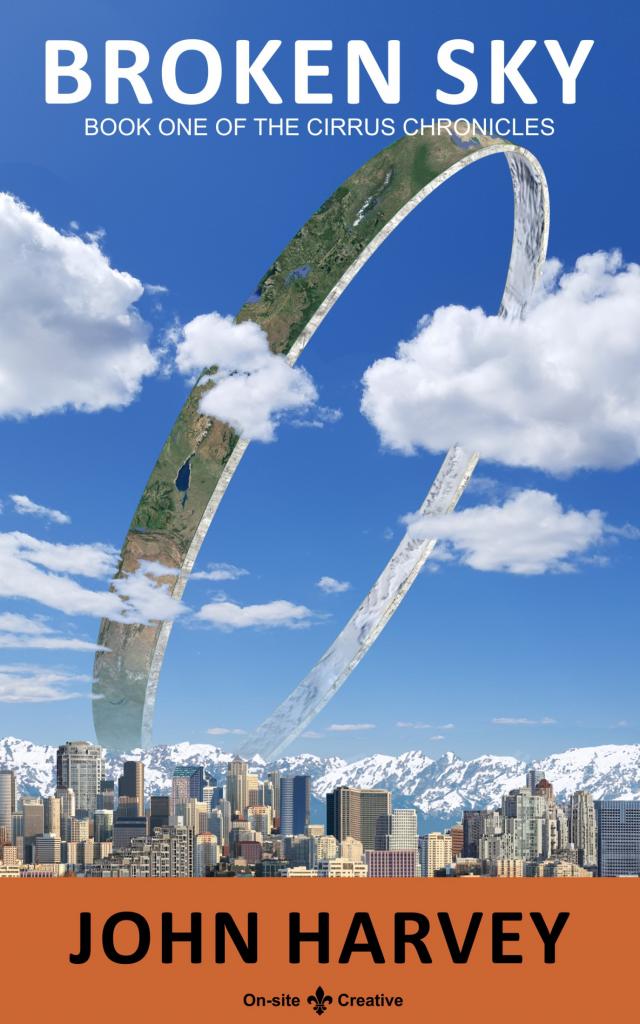
Broken Sky
The Chronicles of Cirrus, Volume 1
John Harvey
Published by John Harvey, 2021.
Contents
Copyright
Dedication
BOOK ONE
Prologue
Chapter One
Chapter Two
Chapter Three
Chapter Four
Chapter Five
Chapter Six
Chapter Seven
Chapter Eight
Chapter Nine
Chapter Ten
Chapter Eleven
Chapter Twelve
Chapter Thirteen
Chapter Fourteen
Chapter Fifteen
Chapter Sixteen
Chapter Seventeen
Chapter Eighteen
Chapter Nineteen
Chapter Twenty
Chapter Twenty-One
Chapter Twenty-Two
Chapter Twenty-Three
Chapter Twenty-Four
Chapter Twenty-Five
Chapter Twenty-Six
Chapter Twenty-Seven
Chapter Twenty-Eight
Chapter Twenty-Nine
Chapter Thirty
Chapter Thirty-One
Chapter Thirty-Two
Chapter Thirty-Three
Chapter Thirty-Four
Chapter Thirty-Five
Chapter Thirty-Six
Chapter Thirty-Seven
Chapter Thirty-Eight
Chapter Thirty-Nine
Chapter Forty
Chapter Forty-One
Chapter Forty-Two
Chapter Forty-Three
Chapter Forty-Four
Chapter Forty-Five
Chapter Forty-Six
Chapter Forty-Seven
Chapter Forty-Eight
Chapter Forty-Nine
Chapter Fifty
BOOK TWO
Chapter One
Chapter Two
Copyright
This is a work of fiction. Names, characters, places and incidents are products of the author’s imagination or are used fictitiously and are not to be construed as real. Any resemblance to actual events, locales, organizations, or persons, living or dead, is entirely coincidental.
BROKEN SKY.
Copyright © 2020 John Harvey
John@johnharvey.net
Published 2021 by On-site Creative
OnsiteCreative.ca
All rights reserved. This book or any portion thereof may not be reproduced or used in any manner whatsoever without the express written permission of the publisher except for the use of brief quotations in a book review.
For Michelle
BOOK ONE
Prologue
The blaze started in a wastebasket—a humble beginning for a fire that would soon burn on the other side of the world.
There was nothing special about the portable office trailer. On a humid summer night, the one-room building sat on a slope in an unlit corner lot of a Louisiana fuel refinery. The trickle of smoke escaping from its open window into the polluted sky was the first sign of trouble.
A battered white pickup waited beside the trailer with its nose pointed downhill. When the burning wall collapsed into the truck’s cargo bed, it landed on a pile of items carefully chosen to increase the fire’s heat. The blaze would not die easily.
The driverless truck lurched down the gravel slope and rolled into an open-ended Quonset hut, where the flames illuminated a maze of pipes. An insulated supply line jutted from the ground, feeding aviation fuel into a network of smaller pipes, which ran through clusters of gauges, then into high-pressure manifolds. And from there …
Chapter One
- Two Weeks to Newton -
Not again.
Jack Scatter dangled his feet over the edge of a rocky cliff, on a world one-hundred and eighty-six million miles from the inferno in Louisiana. He considered hurling himself off the ledge—again—just to see what would happen.
Instead, he flicked a pebble into the nearby creek and leaned forward to watch the water carry it away. The stone tumbled down the steep face, following a familiar path. Far below, the stream twisted through a grassy field saddled between two mountain peaks.
Jack knew he was dreaming.
But this time I’ll do something about it.
For as long as he could remember, he’d been having the same dream. Every detail repeated exactly, except for the ending. From the bare rock he sat on, to the thin clouds in the sky above, to the song of a bird in a nearby bush, he always knew what to expect from one moment to the next.
“It’s time to go, Jack,” the man standing beside him said.
Jack didn’t turn to face the speaker; it was pointless. “What would you do if I just sat here?”
The man replied. But as always, his words became jumbled and muted, as if the answers he’d given in hundreds of dreams had melded into overlapping syllables. It didn’t matter though. Jack already knew; he’d simply walk away and the dream would end.
“We’re somewhere in the Spine,” Jack said. A narrow line of four-mile-tall, snow-capped mountains faded into the distance ahead. “But I can’t find that on any map.”
Round, crater lakes were common on Earth, but the one he pointed to in the nearly featureless plain on his left shouldn’t exist at all on Cirrus. He’d never traveled to Earth—and never would—but the dream was so vivid, so detailed, it had to have grown from a memory. He’d searched maps of both worlds but never found matching terrain. Dark green lines meandered from opposite sides of the lake, suggesting a river course, and the lake itself held a perfectly round island, exactly in its center.
The anonymous man spoke again with a hundred voices that mingled to obscure all meaning.
Jack flung another stone into the abyss. “Why can’t you just once answer a question without sounding like you’re underwater?”
The man walked away. This was the moment Jack was waiting for.
Through the years, repetition had taught him to hold his conscious mind at a level just below waking. That practice now enabled him to dream lucidly—to know when he was asleep and to have partial control over his dreams. Most of them. He’d tried so many things to alter the flow, but this dream always ended in the same spot.
Not this time.
He turned and focused not on the man walking away, but on the forest ahead.
Concentrate. Instead of following the man, he’d try for the forest. He needed to run, but not think about running. If he moved his real limbs, he’d startle himself awake. He fixated on the path bordering the stream, recalling the egg-shaped boulder hidden among the thousands of saplings beyond the meadow. He imagined himself leaping over the knee-high stone.
And then he was there—jogging through the short, evenly spaced trees.
I did it. I skipped ahead.
He’d bypassed half the uphill journey and was nearing the end of the hanging valley where steep walls converged to a point. He swerved through a cleft in a bus-sized boulder and—
The stranger stood below a natural dam, a moraine-like pile of fallen stone, exactly where he’d be if Jack had followed. He pointed to the top of the heap. “… answer.”
“Answer to what?” Jack shouted. “What’s the question?”
The man climbed, leaving Jack and the familiar disappointment at the base of the wall.
“That’s not fair. I beat you. Something should have changed.”
The climber didn’t respond. Jack delayed until he was almost at the summit, wondering if it was worth the effort. But he’d changed part of the dream, maybe this time he could maintain control until the end. He decided to try.
Damp lichen coated the rocks and water seeped from a dozen fissures, but he remembered where the best footholds were. The man was waiting by the mouth of a cave formed by enormous blocks of fallen stone. He spoke again as Jack approached. “… inside.”
Beyond, the valley ended with a small lake surrounded by steep walls on three sides, but it was the sheltered opening that drew Jack’s attention.
Last chance to walk away.
He crouched beneath an overhanging lintel formed by a massive slab of gray rock, knowing he had to surrender control to move beyond this point. If he took the next step, he wouldn’t be able to escape, no matter what the dream showed.
At least that’s how it usually goes.
His stomach knotted as he moved closer, felt cool air at the cave’s threshold, smelled damp moss. It was all so real. He struggled with the balance between dreaming and waking.
And then he was a spectator once again.
Usually, as he entered, voices swarmed from the darkness—indistinct murmurs of hundreds, possibly thousands of people at a great distance. That alone was enough to make him hesitate, but this time was different. This time there was—
Fire.
His dream self pulled back instinctively from the roar and the heat, even though he couldn’t see a flame. It’s just a dream. Just a dream. A shrill alarm pulsed nearby—not a fire alarm, a warning tone. Ignore it. He focused on the cave and smelled gas and oily smoke. It’s so close. Just inside. The enfolding voices grew louder as he leaned farther, reached into the darkness and—
Woke up.
Every. Single. Time.
He’d never been able to stay asleep, to continue dreaming and discover what waited in the cave or learn who the man was. He was certain that these were important, things he once knew but had forgotten. Always, the answers hid from him like a word on the t ip of his tongue.
His heart was pounding. He took several deep breaths to calm himself. The dream had seemed more real than ever; the sensation of fire was almost painful. In the darkness, he rubbed his fingertips, checking for burns. His fingers were fine but he was shaken by the sense of urgency the dream conveyed; something he’d never felt before. Equally troubling, it was occurring more often. It had gone from being an occasional event to almost monthly. This was the second time in just the past week.
Now that his breathing and pounding heart were under control, he lay quietly in his bed and listened. No sound came from within the house but a drone passed in the distance, overwhelming the song of a nocturnal bird in the hedge below his window.
It’s huge, Jack thought. I haven’t heard a drone like that in … I’ve never heard one like that. The machine thwupped more like a helicopter than a smaller, unmanned aircraft.
The large drone sounded as if it was heading for the family workshop in the industrial park. But the familiar rhythm of spinning blades carried an added vibrato. It’s got a chipped rotor. I guess I’ll be replacing that first thing in the morning.
His tiny second-floor bedroom overlooked the fields, not the street. It was small enough for him to roll over and flip the curtain aside without getting out of bed. No landing lights. Instead, he groaned when he spotted the dim numbers on the clock; dawn was still hours away. He wouldn’t get back to sleep; he never did after one of these dreams. Fortunately, school break had already started and he didn’t need to be alert in the morning.
He got up, dressed, and crept down the stairs, even though his mother was a light-sleeper and probably heard him. But she knew he sometimes went to the shop in the small hours, so his stealth was mostly for his father’s benefit.
Instead of using the street, he left the townhouse through the back door and descended to the unlit dirt path that bordered the fields. The temperature never dropped to freezing in Fairview, but his breath clouded the predawn air. He turned up his collar and tucked his hands into his jacket pockets as he hiked the empty mile to the workshop.
-- -- --
There was something unsettling in the way Danny Kou observed people. When Pieter Reynard, CEO of Armenau Industries, entered his top-floor Seattle office, his chief engineer, Simon, was already suffering under that gaze.
Simon had once confided that he believed Danny was a Hopper, someone who could predict a person’s movements seconds before they happened. Pieter had dismissed the idea and warned Simon against such speculation. After all, he knew Danny’s secret; the man could only see half a second into the future.
As Pieter passed without offering a greeting, Simon lowered his eyes and shuffled his feet. It wasn’t just the scrutiny of the head of security making him nervous; he’d brought bad news. But he’d have to endure his misery a while longer—Pieter would not be rushed in his own office. He hung his bespoke suit jacket neatly on the coat stand, brushed a fleck of dust from the sleeve, then poured himself a coffee. Finally, he sat at his desk and motioned for the engineer to speak.
Simon glanced at Danny before handing a tablet to Pieter with the results from the predawn test. “Thirty-seven aircraft were actively refueling on the ground, and one in-flight. It had to make an emergency landing near Lord Howe Island, but no one was hurt.” He wiped his sweaty palms against the seams of his trousers.
Pieter had been scrolling through Simon’s data. A tiny furrow appeared on his brow when he read the comment about the Australian floatplane but he just said, “Continue.”
“The equipment we chose for—” Simon faltered under Pieter’s glare. “That, I chose, for this test, had to be operational. It met all our criteria, but I hadn’t anticipated that the owners might not be using it properly.”
Pieter said nothing. Simon would get to the point faster that way.
“The aircraft was over forty years old and not certified for in-flight refueling.” Simon fidgeted with his buttons. “If they make a public complaint, they’ll lose their permits. They’re upset, but there’s no reason for them to check the portal crystals before they ship the old units back to us.”
Pieter’s family had been in the transportation business for generations. He understood why the tour company had risked fines: profit. A full tank at take-off reduces cargo weight and therefore the number of paying passengers. In theory, an aircraft with a wormhole-based refueling system could fly indefinitely, but was legally required to carry enough reserve fuel to reach the nearest airport.
Simon continued. “The pumping station in Louisiana was destroyed as … as planned. No injuries there.” He subconsciously shuffled a half step back from the desk. “But the roof collapsed and tore the fuel manifold apart before the final phase. That was unexpected, and it briefly exposed the wormholes, which led to small fires in several other cities, but only minor smoke damage.”
Pieter had been reading as Simon talked and had already finished the section covering the secondary fires. He considered the news for only a moment. “It’s unlikely anyone will link the events. Our official position is unchanged—the fire forced us to cut the fuel supply as a precaution. Pass requests for information directly to me and prepare for the next round of tests.” He said this casually, but an underlying tone made it clear he would tolerate no more delays.
Simon hesitated. He glanced at Danny, standing silently behind Pieter, and retreated another half step. Danny, like Simon himself, was of average height, but muscled like an Olympic gymnast. That and his unrelenting glare made him more intimidating than Pieter, who was broad-shouldered and stood six inches taller.
“There was a second problem,” he finally said. “Our instruments recorded every crystal shattering as expected, only not until the pressure rose slightly higher than projected.”
Pieter had skipped the actual measurements. He understood the principles but left the details to the engineers. “What caused that?”
“It may just be an instrumentation error, except … well … except that the extra pressure works out to be precisely what it would be if there were two more crystals.”
“Another active pair?” Pieter’s voice was controlled but menacing. “Where?”
“Now that they’ve been destroyed, there’s … there’s no way to tell.” This time it was a full step back. “I’ll keep working on it and let you know as soon as I have an answer.”
Pieter dismissed the engineer but called him back before he reached the door. “Wait. The floatplane. It says here they’re grounded until they get the new fuel module.”
“That’s right. The courier has already delivered the upgrade package to their hangar. They’re just waiting for one of their other aircraft to become available.”
“We have a helicopter in Sydney. As a courtesy, pick up their mechanic and fly him out to the island. Have our pilot collect the old modules while they’re finishing the repair.”
Simon smiled, unable to hide his surprise. “That … that’s very generous. I’m certain that’ll go a long way to smoothing things over.” He was still smiling when he left the room.
Pieter waited for the door to close. “Make sure that airplane never makes it to the mainland.”
Danny nodded and began typing on his phone. A whiff of oily smoke drifted from his clothes.
Pieter picked up a gleaming sphere of white quartz from a wooden pedestal on his desk, then spun his chair to face the window. Despite the persistent haze, he’d have a fine view of Lake Washington from the ninety-sixth floor when the sun came up—few buildings in the city were equal to or taller than his own. Except for the conference room, his office and other private spaces took up the entire floor, but the view from this corner was his favorite. Even his overbearing father would have been impressed.
He raised the sphere to examine it more closely. “The extra crystals. Can you track them?”
Danny lowered his phone. “If there are records, I’ll find them. Do I have your approval?”
Approval. The meaning between them was clear. For Danny, making an aircraft and its crew disappear was trivial—the waters were deep enough off the coast. But when he asked for approval it meant he expected to hire external contractors through multiple layers of secrecy in order to hide the connection to Armenau. The operation would be expensive.






