Three rings, p.1
Three Rings, page 1


THREE RINGS
ALSO BY DANIEL MENDELSOHN
Ecstasy and Terror: From the Greeks to Game of Thrones
An Odyssey: A Father, a Son, and an Epic
Waiting for the Barbarians: Essays from the Classics to Pop Culture
C. P. Cavafy: The Unfinished Poems (translation)
C. P. Cavafy: Collected Poems (translation)
How Beautiful It Is and How Easily It Can Be Broken: Essays
The Lost: A Search for Six of Six Million
Gender and the City in Euripides’ Political Plays
The Elusive Embrace: Desire and the Riddle of Identity
UNIVERSITY OF VIRGINIA PRESS
Charlottesville and London
Page-Barbour Lectures for 2019
University of Virginia Press
© 2020 by Daniel Mendelsohn
All rights reserved
Printed in the United States of America on acid-free paper
First published 2020
ISBN 978-08139-4466-1 (cloth)
ISBN 978-0-8139-4467-8 (ebook)
1 3 5 7 9 8 6 4 2
Library of Congress Cataloging-in-Publication Data is available for this title.
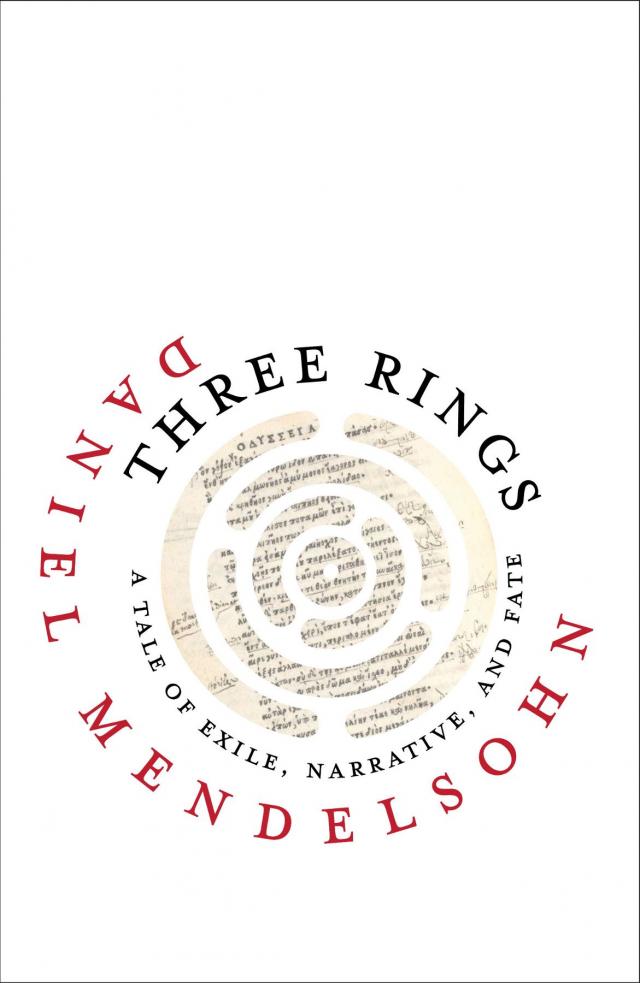
Cover art: Page from Greek edition of Homer’s The Odyssey (Omerou Illias = Homeri Illias, vol. 2 [Venice: Aldus, 1504]). (Special Collections Research Center, University of Chicago Library)
For Glen Bowersock and Christopher Jones
Tu se’ lo mio maestro e ’l mio autore;
tu se’ solo colui da cu’ io tolsi
lo bello stilo che m’ha fatto onore.
CONTENTS
PART 1
The Lycée Français
PART 2
The Education of Young Girls
PART 3
The Temple
THREE RINGS
1
THE LYCÉE FRANÇAIS
Il valente uomo, che parimente tutti gli amava, né sapeva esso medesimo eleggere a qual più tosto lasciar lo dovesse, pensò, avendolo a ciascun promesso, di volergli tutti e tre sodisfare; e segretamente ad uno buono maestro ne fece fare due altri, li quali sì furono simiglianti al primiero, che esso medesimo che fatti gli avea fare appena conosceva qual si fosse il vero.
The worthy man, who loved them all alike and knew not himself how to choose which one he ought to leave the ring to, considered that, having promised it to each one of them, he should like to satisfy all three; and in secret he had a master craftsman make two other rings which were so similar to the first that he himself, who had ordered them made, scarcely knew which was the true.
—BOCCACCIO, The Decameron, Day 1, Third Novella
A STRANGER ARRIVES in an unknown city after a long voyage. He has been separated from his family for some time; somewhere there is a wife, perhaps a child. The journey has been a troubled one, and the stranger is tired. He stops before the building that is to be his home and then begins walking toward it: the final short leg of the improbably meandering way that has led him here. Slowly, he makes his progress through the arch that yawns before him, soon growing indistinguishable from its darkness, like a character in a myth disappearing into the jaws of some fabulous monster, or into the barren sea. He moves with difficulty, his shoulders hunched by the weight of the bags he is carrying. Their contents are everything he owns, now. He has had to pack quickly. What do they contain? Why has he come?
FOR A PERIOD of several years early in the new century I was working on a book the research for which required me to travel extensively throughout the United States, Eastern Europe, Scandinavia, Israel, and Australia. I went to those places in order to interview a number of survivors of, and witnesses to, certain events that took place during the Second World War in a small eastern Polish town where some relatives of mine had lived. These relatives were ordinary people, of little interest to history but nonetheless the focus, the center so to speak, of the story I wanted to tell, about who they had been and how they had died; just as the town itself, a place of little historical importance, had yet been the focus of my relatives’ lives, the fixed point from which they had never wanted to stray. And so they died there, some hidden quite close to the house where they had lived, only to be betrayed; some rounded up and shot in the town square or in the old cemetery nearby; some transported to remote locales and then gassed. From this small place the few survivors would later radiate outward, after the war was over, to distant parts of the world—places that, only fifteen years earlier, would have struck these townspeople as improbable, absurd even, as destinations, let alone as places to live: Copenhagen, Tashkent, Stockholm, Brooklyn, Minsk, Beer Shevah, Bondi Beach. Those were the places I had to go, sixty years later, in order to talk to the survivors and hear the tales they had to tell about my relatives. The only way to get to the center of my story was by means of elaborate detours to distant peripheries.
When I was finished writing the story I found myself unable to move. At the time, I told myself that I was merely tired; but now the distance of a decade and a half permits me to see that I had experienced a crisis of some kind, even a kind of breakdown. For some months I found it hard to leave my apartment, let alone to do any traveling. I had been to Australia and Denmark and Ukraine, Israel and Poland and Sweden, been to the mass graves and to the museums, including one in Tel Aviv where, to my surprise, the thing that moved me most was a room full of meticulous models of synagogues that had, over the millennia, been built throughout the territory of the Jewish diaspora: in Kaifeng, China, and in Cochin, India, the sixth-century Beth Alpha Synagogue in Lower Galilee and the twelfth-century Santa Maria la Blanca Synagogue in Toledo (which owes its strange name to the fact that, shortly after it was built by a special dispensation from King Alphonso X to create “the largest and most beautiful synagogue in Spain,” it was attacked by mobs, partly destroyed, and subsequently reconstituted as a church dedicated to the Virgin); the nineteenth-century Tempio Israelitico in Florence and its contemporary the Oranienburger Straße Synagogue in Berlin, both largely destroyed by fire in 1938 and now painstakingly re-created in miniature in Israel, a country that did not exist when those buildings were gutted. I was so moved, I think, because at one point from late childhood to early adolescence I myself had been an obsessive model-builder, carefully constructing precise scale replicas of ancient buildings, the mortuary temple of Egyptian pharaoh Hatshepsut in Deir el-Bahri, the Parthenon in Athens, Rome’s Circus Maximus, each of those structures characterized, as I can now see although I doubt I was conscious of it at the time, by the insistent reduplication of a given structural or decorative element: ramps, columns, arches. I suppose I found the repetition reassuring. At any event, this is why, as I stood there in the model room of the museum in Tel Aviv, halfway through the worldwide journey I undertook in the early 2000s, I had such a strong emotional reaction. I was familiar with the impulse to make such replicas, which is haunted by a poignant paradox: the belief in our ability to re-create and the acknowledgment that the original has been lost . . . “Lost,” I should say, can be a misleading word, implying as it does destruction beyond the point where reconstruction is possible. But there are other kinds of loss, alterations or repurposings of structures so extensive or dramatic that, although the original still stands, is still present, we might nonetheless feel the need for reconstruction of the sort to be found in the Model Room at Beth Hatefusoth in Tel Aviv. There is, for example, a decaying but still handsome structure that dominates the market square of a small sub-Carpathian town called Bolekhiv, currently located within the borders of Ukraine although it was part of Poland when my relatives, who called it Bolechów, lived there, as their relatives before them had done for many centuries until 1943, when the last of them perished. This large rectangular building, its pale pink stucco walls pierced at regular intervals by a series of elegant tall windows with rounded tops, was once known as the “Great” Synagogue of the town—a slight pretension that can be forgiven when you consider, first, that there were at one time more than a dozen synagogues of various sizes in this small market town, and, second, that most of the other buildings in Bolechów were in fact quite small in comparison. The epithet “Great” can, if anything, strike you as poignant now, given that there is not a single synagogue left in that place and that every single person who ever attended those houses of worship, every person who ever familiarly referred to this structure as the Great Synagogue, is long since dead; and that almost none of the people who live there now are aware that it was once a place of worship. This is not surprising. In the 1950s, long before the vast majority of the current residents lived there, the building had been converted into a meeting house for leather-workers, its walls painted with murals celebrating the landscapes of the Ukrainian Soviet Socialist Republic, and a decade before that the ark of the Torah, once the focal point of its architecture, had been ripped out, its scrolls defiled and lost, its decorations stripped off. Hence although you could say that the Great Synagogue of Bolechów still stands, it seems nonetheless to have been “lost,” seems to be in need of a model that could show you what it looked like when it was first constructed, the product of a living civilization. The historical reality which a model of an old building is meant to suggest is, therefore, more than merely material; such a model is surely meant to capture the (as it were) soul as well as the appearance of a building . . . But all this is a dream. There is no model of the Bolechów synagogue in the Beth Hatefusoth Museum, partly because no one who could help reconstruct its lost reality is alive today, and partly because if the museum were to re-create in miniature every synagogue in every town in Eastern Europe that suffered the same fate as the synagogue in Bolechów, it would take up acres, rather than a single room, in Tel Aviv.
The trip to the Model Room was the only occasion when I cried during my travels. Later, during the period of immobility that followed my return home, I would sometimes find myself in the middle of a room, looking around, unable to remember why I had entered it; standing perplexed in this way, motionless, I would burst into tears. A psychiatrist friend of mine suggested at the time that I was experiencing a kind of post-traumatic event. Having listened to tales of violence and destruction for five years without being able to assimilate them emotionally (because at the time I was listening to them my only thought was to “get the story down”), I was now, my friend surmised, having a delayed reaction. It was here, back in the familiar space of my home, that (she said) I was “doing my grieving.” Whatever the reason, I felt emptied, emotionally and creatively. Every time I tried to begin a new project it was as if I had become one of the elderly witnesses or survivors I’d written about: a vacant wanderer arrived at last at a blank new place, unable to go on.
This strange state persisted for some time after I returned from my final research trip, which I took in July of 2005 and which brought me at one point to eastern Poland, where I saw the newly opened memorial of the Belzec death camp. It is a striking monument which is, so to speak, all periphery and no center. The memorial itself consists of a vast field where a large part of the camp had been situated. (The word “camp” can have misleading connotations. Belzec was a death camp, not a labor camp, which means it had no barracks, no sleeping quarters, nothing to suggest a habitation: you got off the train, as a great-aunt of mine did in September 1942, walked through the narrow passage known as der Schlauch, the hose, and went to the gas chamber.) This field has now been filled with stones of varying sizes, some of them as big as boulders, others as small as pebbles, that appear to have been burned. This impressively enormous space, with its suggestive barrenness—we understand that it is a place where nothing will ever live or grow—is in fact off-limits to the visitor; the commemorative act consists of walking around it. A paved path goes all the way round the field of burnt stones. Attached to this pavement are bronze letters and numbers, which also appear to have been burned, or perhaps badly rusted, and which spell out the names of every city and town in Europe from which a transport of human cargo went to Belzec, and the date or dates on which these transports took place. To walk along this path is, then, to retrace the history of Belzec as a killing field. Because many municipalities, even small towns such as the one I was writing about, had more than one transport to this death camp, and because the creators of this monument had decided that the names of the towns and cities should appear as many times as there were transports from those places, in the correct chronological order, there are certain place-names that appear and then reappear as you progress from MARCH 1942, the month of the first transport, to JUNE 1943, the month of the last—a scant fifteen months in which, nonetheless, six hundred thousand people were gassed—the foreign syllables becoming increasingly familiar, so that you almost find yourself looking for them, much in the way that certain characters or motifs in a play or a novel will make their mysterious entrances only to lose, as you keep watching or reading, their strangeness and become, finally, recognizable. The walk around the perimeter of the field is tiring.
That was, as I have said, in 2005. In 2008, on the advice of a friend who suggested that I return to what she called my “intellectual roots,” I began to entertain the idea of writing something about the Greek classics. Although at first I was still incapable of beginning a new book, the idea of writing on a purely literary subject, on something whose charm and inventiveness, whose fantastical characters and settings and intricate construction would beguile and distract my still-bruised mind, appealed to me more and more as the months and then years passed. Wherever else it might lead, I thought, this Greek, this literary subject would at least allow me to leave behind the anguishing stories that had haunted me for so long and, in time, immobilized me: the tales of political collapse and religious intolerance, of escapes both successful and failed, of displacement and refugees, Germans and Jews. Soon after my friend shared her thought with me, the long period of morbid inaction I had been experiencing began to yield to one of reading and animated contemplation until, toward the end of that first decade of the century, for reasons I ended up describing in the book that I eventually wrote, it became clear what my subject would be. I decided to write a book about the Odyssey.
AS IT TURNED OUT, the book was difficult to write: so difficult that there were many occasions when I thought of abandoning it. I was baffled, balked: like some enchanted character in an old tale, the story I wanted to tell kept changing shape, shifting away from me, slipping from my grasp. The problems I was having with the Greek book were not at all like those I had experienced while writing the Holocaust book. The emotional despair that had characterized my relation to that book had yielded, in the new project, to what I can only call narrative despair.
Although there was a period when I studied Classics at the highest level, the book I was trying to write was not a scholarly work. It is, rather, about the last year of my father’s life, which turned out, strangely enough, to be refracted through the Odyssey. In January of 2011, at the age of eighty-one, my father had decided to sit in on a first-year seminar on the epic that I was teaching, an experience that, despite the comic potential of the situation, had a profound impact on him, the students, and myself. In June of that year, just after the course ended, we heard about a Mediterranean cruise that purported to re-create Odysseus’s voyages. We decided to take it, and the voyage turned out to be an experience during which a transformation of sorts took place in my father, a metamorphosis into a version of himself I had never glimpsed during our lives together. Then, in the autumn of the same year, he fell in a parking lot and suffered an injury that, in time, led to a massive stroke and, in still more time, to his death.
These experiences were profound, both intellectually and emotionally. But it was neither their depth and complexity, nor the awkwardness of some of the feelings that would rise to the surface in the classroom or the stateroom or the intensive-care unit, that baffled me, made the writing so difficult. The problem, as would become clearer as a year of writing became two and then three, was that I had no idea how to organize the story.
I had begun writing in the fall of 2012, six months after my father died, and by the end of August 2016, I had six hundred manuscript pages. Each of the three sections had been written, the classroom and the ship and the hospital, and yet the narrative as a whole wasn’t working; reading through it was strangely tiring. As the summer came to an end and I despaired increasingly of finding a way to make the narrative work, I decided to seek out a friend of mine, an editor who has been a mentor to me since I began writing, nearly thirty years ago. I gave him the manuscript, and within a day he called me. The problem, this mentor of mine said, was that I had all the pieces but they hadn’t yet come together. There was something wrong about the way I was telling the story, he went on; it was one thing after another, the seminar, the cruise, the illness and death. There was a lot of incident but it wasn’t yet a story. The first part, the account of the seminar, was interesting (he observed, after a small silence during which I absorbed his criticism), but in his opinion the problem was that once you reach the end of that part—once you come to the end of the Odyssey course—you didn’t want to keep reading. You don’t want to get through the whole semester and then have to go on a cruise, he said, at which I weakly protested, But that’s how it happened. I don’t care how it happened, he returned, this isn’t about fact, this is about a story. You need to find a way to plant the cruise and the hospital within the narrative of the seminar. Use flashbacks, use flash-forwards, don’t worry about chronology. Make it up, if you have to! You just have to find a way.