

Cassia, p.1
CASSIA, page 1


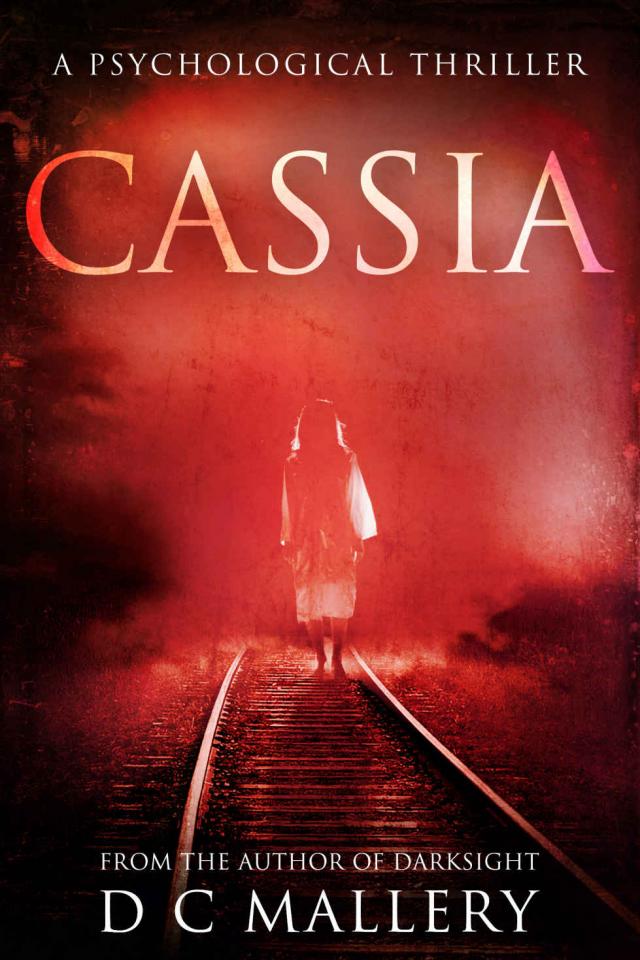
CASSIA
D C MALLERY
TESSELESSET BOOKS
Valencia CA, USA
Copyright © 2021 by Daniel Mallery
All rights reserved. No part of this publication may be reproduced, distributed or transmitted in any form or by any means, without prior written permission.
TESSELESSET BOOKS,
Valencia, CA
www.TesselessetBooks.com
This is a work of fiction. Names, characters, places, and incidents are a product of the author’s imagination. Locales and public names are sometimes used for atmospheric purposes. Any resemblance to actual people, living or dead, or to businesses, companies, events, institutions, or locales is completely coincidental.
Cassia/ DC Mallery. — 1st ed.
PRINT EDITION ISBN: 978-1-7353386-0-6
E-BOOK EDITION ISBN: 978-1-7353386-2-0
Cover design provided by The Cover Collection
For my mother and father,
both gone now,
but never forgotten.
PROLOGUE
She was running free now, running hard under the empty sky, running hard to the dark woods, her little feet kicking up a world of dust.
She heard the wicked curses behind her as she crashed through a wall of branches, looking for somewhere, anywhere, to hide. She was growing dizzy. It must be the medicine. The nasty medicine. She stumbled sideways, staggering like she’d just gotten off a merry-go-round. That feeling of giddy dizziness was often so much fun. Now, it terrified her.
The men were getting closer, thrashing through the bushes, bellowing. Her white nightgown caught on some branches, and she had to waste time tugging herself free.
“Where you at, sweetie? We ain’t gonna hurt you.” She knew that voice. It was her dad.
She plunged deeper into the woods, hoping to lose herself in its darkness, but whacked headlong into a fence, its old wooden planks bristling with splinters. The fence disappeared into the gloom in both directions. She tried to make her way to the left, looking for a way through, but her legs now felt like rubber. She tumbled to the dirt. She spotted a small gap under the fence, probably dug by some clawed animal. Not too small, she hoped, but maybe small enough.
Frantic, she tried to wriggle through the rut. She got halfway through and could see railroad tracks on the other side. Maybe a train would come. Not a kiddie train like she sometimes rode at carnivals, but a real train. It could take her away. It could save her.
Too late, the voices found her.
“There’s the little bitch.”
Fists clamped around her ankles.
“Come on back, sweetie.”
She caught hold of a thick tree root on the far side of the fence and wrapped her arm around it. She held on tight. Her dad and the other man yanked at her, but her hold on the root was strong.
After a few more tugs, they gave up. “Do it here. Finish her off.”
“Is there even enough left?”
“Just do it!”
She felt the sting of a needle in the back of her thigh. It hurt so bad.
As her world grew black yet again, she jammed her fingers in her ears, for the whispery and demented voices would soon return.
The voices that would never leave.
She knew this all too well. For she had fought to escape under that fence more times than she could remember. They always found her. They always caught her, and those cold and whispery voices never truly left.
PART ONE
CHAPTER ONE
Taverton City, New York, Present Day
Like a child defying his parents, Dr. Jack Temple sat too close to the TV, cross-legged on the living room floor. Bathed in the flickering gray light of the screen, he tried to understand the troubling experimental results recorded in the video. He had taped it the day before in the clinical lab at St. Vincent’s. It was a clunky old VHS cartridge, virtually medieval, but that was what St. Vincent’s Psychiatric Hospital still used. In the recording, the scrawny arm of the elderly female patient, little more than bones wrapped in skin, reached out to touch images on a computer screen.
Yet the woman refused to believe she was doing anything at all.
“That’s not me,” she had told him during the session. “It’s my arm but that’s not me.” When he asked her who was touching the screen, she shook her head and grew agitated, as though the question made no sense.
It was the drug, of course. The Kyronane. Jack’s discovery of the remarkable side effect he observed in the elderly woman and in other patients could be important, he figured, maybe even groundbreaking. Or maybe it would all come to nothing. He paused the video and caught a glimpse of himself in the screen’s reflection. He didn’t like what he saw. The pale early morning light exposed a patchwork of faint wrinkles around his otherwise sharp blue eyes. The gloom betrayed the gray that had begun to weave its way into his mess of sandy hair over the last few years.
Jack stretched his stiff back and glanced at the mess around him. Scientific charts were scattered about the living room floor. Thick medical texts were propped open, bindings splayed, pages dog-eared. Smitty, their aging tabby, lay across a couple of the books, sleeping imperiously. From amid the clutter, Jack dug out a chemical diagram of the Kyronane molecule itself—a long and twisted beast of a compound. Synthetic and potent.
Suddenly, the sheet was yanked from him.
“You’d rather spend the night with it instead of me,” his wife Wendy teased, eyeing the molecular compound with mock jealousy.
Jack tried to snatch the sheet back, but Wendy leapt onto the couch, then darted to the kitchen as he chased her, then back to the living room couch, then the love seat, leaping one to another, squealing the whole time.
A blur of color, a streak of energy, a dervish.
Jack envied her timeless youth. Short brunette hair and gamine brown eyes. Perpetually rambunctious. Few would have guessed Wendy was already mid-thirties too. She always took a bit of snickering pride in still being carded at bars and pubs. This annoyed him because he was the same age but looked years older, felt years older. She must have been up for a while, he realized. She was already dressed for work. Funky and stylish, as usual, an outfit he hadn’t seen before. She had the uncanny ability to conjure endless new outfits from her closet, despite the amount of paint so often splattered on her clothes by the end of the day, ruining them.
As Wendy darted away once more, Jack caught a glimpse of Smitty. The cat yawned and eyed the both of them, aloof and bemused.
A dervish he was not.
“How’s your presentation coming along?” Wendy finally asked Jack, catching her breath, handing back the diagram. She gave him a kiss, then flipped on the room lights and threw open the curtains of the bay window. Fresh snow lay outside beneath a gray January sky, a few flurries still falling.
“Well,” Jack replied but didn’t want to say anything yet about his discovery, so he left it at that.
“You’ll do fine!” Wendy called back as she darted into the bedroom. “And don’t forget about tonight!”
He wouldn’t. The charity art auctions she arranged—always held in stylish locations and lubricated with potent drinks—were memorable affairs. He might be hung over for a day or two afterward, but he’d never miss one. Wendy bounded back into the living room, bundled now in a long dark woolen coat, a big artsy bag thrown over her shoulder, a knit cap snug atop her head. A few of her brunette curls peeked out.
“Jack?”
He heard her, but the VCR started again, its internal pause timer having expired. He was drawn once more by the images on the screen, watching as the scrawny arm of the elderly patient reached out to make a connection that somehow wasn’t there. “That’s not me.”
#
“Jack?”
Wendy gave up, seeing him staring again at the TV, a video running, some elderly woman absentmindedly pushing buttons on a touchscreen in a lab. Wendy was annoyed but chose not to say anything. Instead, she dug in her bag, found an invitation to the auction and left it near their home answering machine. He’d spot it later. She kissed the top of his head before sprinting out the front door into the cold morning.
Outside, fresh snow hushed the neighborhood. Mid-century craftsman homes stood, squat and proud, along the tree-lined street. A few flurries still fell from the storm, but the heart of it had passed overnight, leaving a few inches, calm and untrampled. She nearly slipped on the way to her car, ice hidden under the snow. She pulled on leather gloves to brush the windshield. As she wiped off the snow, she felt oddly chilled.
It was a deep body chill that went beyond the crisp winter morning. It felt as though her body’s thermostat was somehow off. She hadn’t mentioned it to Jack yet, not wanting to worry him, but she had felt the odd chills for a couple weeks now. They seemed to be growing worse.
Lost in her thoughts, a scarf was whipped over her head, pulled tight against her throat.
“Wen, you’ll catch your death of cold,” Jack said playfully. He then straightened the woolen scarf—cranberry red and hunter green—and gave her a quick hug.
“Catch me.” With her back to him and the hush of the still morning in her ears, she let herself fall backwards, arms outstretched, knowing he would catch her. Instead, she plopped awkwardly in the snow.
In shock, she spun to see Jack already heading inside. “Hey!”
She charged, tackling him before he could reach the porch. They tumbled in a heap, snow flying everywhere, little fingers of ice ge tting under her coat, slipping under her blouse, sliding around her breasts, shivering her. She tried to pin him, but he was quick when he needed to be. Suddenly he was on top, then she, then he again, wrestling like cubs at play.
Fighting through laughter, she shoveled snow at him.
“Oh. That’s the way you want it!” Jack howled, his strong hands pitching walls of powder back at her.
She was hit with so much snow she couldn’t take a breath without it filling her mouth, a mouth now so eager for his, so hungry for him. She straddled him and kissed him, crushing her lips to his, her tongue inside his mouth. Her frantic breaths, fogging the cold air, mingled with his.
“Maybe we should take this inside?” she whispered. She wanted to race back into the house, toward the bedroom, but not get past the throw rug in the foyer, clothes tossed aside, rug burns on her knees. That would warm her up nicely.
His eyes darted to his watch, and she knew it wouldn’t happen. His thoughts were back to his latest obsession, back to the patient videos he’d been watching all night, back to the new drug he was testing. She admired his single-mindedness, her own thoughts often too scattered to focus on any one thing for long. She respected his devotion to his job and his patients, but it hurt nonetheless to no longer be his sole obsession.
Catching her breath, Wendy pushed away from him.
She made a gesture of checking her own watch. “I have to go.”
“You sure?”
“Never keep second graders waiting. Not in a room full of glue and papier-mâché.” She kissed him again, on the cheek this time, then headed to her car. Dusting snow from her coat, she walked carefully, cautious of hidden ice. Her body felt oddly chilled again. She tried not to let it worry her.
#
Back inside the warmth of their home, Jack returned to the TV to watch the video again. Prompted by gentle off-screen questions, the elderly patient touched faces on the clinical lab’s computer screen. “Which face looked angry? Which looked sad? Which looked happy?”
It was a simple Empathy Test to assess those who lacked the ability to recognize emotions in others. The woman answered every question correctly. That was remarkable, for the patient, a seventy-two year old woman with acute schizotypal personality disorder, had never shown any ability to distinguish emotions in others—indicating a severe impairment in the mirror neuron networks of her frontal lobe.
With the experimental drug, she got all the answers right.
Jack rewound the video and watched again. Before injecting Kyronane, the patient tried hard to choose the correct faces. She tried and failed. Jack had then injected the shimmering blue drug into her arm, not much, only 1 CC. Her eyes glazed over. It seemed as though she wasn’t even listening to the questions anymore, but she passed the test perfectly. Remarkable, especially since Ryker Pharmaceuticals had not designed the drug to enhance empathy but to reduce obsessive-compulsive behavior.
Even more remarkable was how the patient insisted she wasn’t doing anything, that it wasn’t her. That’s not me. Other patients exhibited similar effects, at least at certain dosages, at least temporarily. She was the eighth patient he tested who exhibited the same remarkable behavior. As Jack began collecting his videos and notes to take into St. Vincent’s, he mulled over the fact that in just a few hours he would be testing the drug on the final psychiatric patient in his experiment: Edmund Lewis Lasker.
The mere thought of that psychopath chilled his blood.
CHAPTER TWO
Trying to keep warm, Lillian Anderson clicked her heels against the stone steps of St. Vincent’s. Her eyes darted between her watch and the wrought iron entry gate of the staff parking lot. Cold breath fogged her thick glasses, funky “librarian” ones she chose for the way they framed her eyes. Anything to distract from the shoulder-length brown hair she felt looked too mousy. She knew the drab woolen clothes she always wore didn’t help. “Salvation Army chic,” her mother often chided. “If we gave you a bell and a bucket, passers-by would be tossing coins. You’ve got a real job now. Let’s throw those old clothes away.” Lillian refused. Not yet.
Above her, the grimy edifice of the asylum brooded over the sprawling grounds and rural landscape that lay beyond, casting its gloom against barren woods, against slate gray skies. Light snow swirled about the old clock tower, drifted past the stonework façade of the main building. Her pestering inner voice said she should wait in the warmth of the lobby, but she defied that voice, letting the flurries drift around her too, burrowing into the stack of charts she clutched tight. She finally spotted Jack’s SUV enter the gate. She gave him a bright wave and trotted to the parking lot to meet him, her black leather boots crunching along the icy path.
“Remember those tracking charts I couldn’t possibly get done in time?” she asked Jack, showing him the charts as he climbed from his vehicle, her face scrunched into a buoyant grin. “I got them all done.”
“Lillian! You must have been up all night.”
She blushed. “You, too?”
“Don’t ask.” He laughed into the stirring breeze.
She could tell from the bags under his eyes he had stayed up too, but he still looked great, like Jack Bauer from that old TV show, just without a gun. Silly schoolgirl, her inner voice teased. She helped him gather his load of books and papers, as the breeze tugged at them, ruffling the pages.
“We’re still set for ten?” she asked as they hurried up the stone steps toward the entry lobby.
“That’s when the Ryker reps are due to arrive,” Jack replied.
“It’s okay for them to observe? What if something goes wrong?”
“With Edmund Lasker? I’ll make sure he’s on his best behavior. Me and a few orderlies and a straitjacket, a sturdy one.” He grinned at her.
She tried to smile at his little joke but couldn’t forget what the man had done to all those young women with his combat knife. She could picture the blade in her mind. A sharp edge drawn across pale skin, blood beading along the wound, then gushing as it cut deeper. She tried to push those nauseating images from her mind as she followed Jack through heavy doors into the spacious lobby of the main building. Threadbare couches and chairs lined the sidewalls and filled some of the space in the middle of the entrance hall. Ahead, an equally threadbare old security guard, Charley Callah, buzzed them in. A bank of black and white security monitors towered behind him, displaying blurry images of patients and staff.
Lillian hurried to catch up with Jack, her heels clattering on the tile, the sound echoing weakly within the lobby’s high recesses, dying there.
#
Jack pushed his way into the main hall of the minimum security ward, with Lillian following close behind him. Despite windows set high amid its alcoves and a row of heavy mercury lamps hanging above, the vast space was poorly lit, leaving pools of perpetual shadow. Faded tile stretched into side rooms where TVs flickered. Dozens of patients loitered about, many in wheelchairs, others with walkers. Some paced nervously. Others were eerily still.
Jack was anxious to get to his lab, which was in the maximum security ward. Its guarded entrance beckoned ahead, but a clutter of patients gathered around him, as they did whenever a staff physician passed through. An emaciated young woman stumbled in front of him. Mumbling, her boney fingers clutched his white coat. He turned to her, smiling warmly. He put an arm around her shoulder. “What’s wrong?”
He listened as she complained of a dozen things, of voices heard and unheard, and the fact the TV in the rec room didn’t get Channel 0, and how the tiles on the floor rearranged themselves as she walked. None of it made sense but that didn’t matter. It was important to let her talk, to let her get the words out. What was most important, Wendy had often reminded him, was not what was said but that there was someone there who would listen.
As Jack listened, he let Lillian take his share of the stack of research papers. He saw her eyes wander along the patient’s spindly right arm, along the veins of her pale forearm to a series of rough scars at the wrist. The scars on the patient’s arm went the wrong way. Side to side. Not along the veins. A cry for help, Jack knew. Not a serious suicide attempt. Lillian stared at them nonetheless. Her legs wobbled, and all the papers she held spilled to the tile floor at her feet, as blood might spill from an open wound.






