

Prodigal son, p.1
Prodigal Son, page 1


Begin Reading
Table of Contents
Copyright Page
Thank you for buying this
Tom Doherty Associates ebook.
To receive special offers, bonus content,
and info on new releases and other great reads,
sign up for our newsletters.
Or visit us online at
us.macmillan.com/newslettersignup
The author and publisher have provided this e-book to you without Digital Rights Management software (DRM) applied so that you can enjoy reading it on your personal devices. This e-book is for your personal use only. You may not print or post this e-book, or make this e-book publicly available in any way. You may not copy, reproduce, or upload this e-book, other than to read it on one of your personal devices.
Copyright infringement is against the law. If you believe the copy of this e-book you are reading infringes on the author’s copyright, please notify the publisher at: us.macmillanusa.com/piracy.
Jesus continued: There was a certain man who had two sons. One day the younger one said to
his father, “I’m thirty.”
And the father said, “That can’t possibly be right. Thirty?”
And the man’s wife, the sons’ mother, said, “Thirty? That can’t be right.”
And the father said, “It can’t be thirty. Perhaps you meant fifteen. I might be willing to go as high as sixteen, but no further.”
“Not sixteen,” the mother said. “Surely not that high.”
And the elder of the two sons said, “Get a load of this asshole, calling himself thirty.”
And the mother said, “Who told you that you were thirty? You can tell us, you know. We’re not angry with you. But we are worried—desperately worried, and heartbroken—that some vile, skulking stranger, someone with sinister intentions, would try to convince you of your thirtyness.”
And the father said to all his family and all his servants, “I will offer a reward of fifty denarii to anyone who brings me the stranger trying to chisel my children from the family that bore them.”
And the elder brother said, “I am not even thirty. I have labored for my father all my life. Not once have I disobeyed his orders, nor asked for even a young goat to feast on with my friends. If with all this I am not thirty, how is it that you claim to be?”
And the foremost of the man’s servants, who had been the longest in his service, said, “Sir, I have served you long and faithfully, and never have I even considered asking your leave to turn thirty. Nor would any member in all your household choose to waste their years so extravagantly.”
And the younger son said, “Look, let’s not argue about it. Just let me take anything with my name written on it, and I’ll get out of your way.”
And his mother said, “Your name!”
And his father said, “It’s terribly funny, but I don’t remember your having much say in the matter when we named you.”
And the mother said, “It seems to me that I remember choosing a name for you.”
“You chose wonderfully,” the father said. “A great gift, and better than he deserved.”
“Perhaps he named himself,” the elder brother said. “Perhaps he bore himself, and named
himself, and turned himself thirty. Perhaps he chooses a goat every year, to feast on with his friends, and names them, too. Perhaps he is my father and was not born after me at all. Perhaps I merely forgot the order of things.”
The boy’s mother said, “I remember the day you were born like it was yesterday.”
And his father said, “It was yesterday, darling. Our youngest son is a single day old.” Then to certain of his servants he commanded that they bring his wife hyssop and wine, and swaddling clothes for her newborn babe. Then he sent others to slay a fatted calf, all red and unblemished, in honor of the birth of his second son, and declared a feast day for all who labored in his household.
And the son said, “Oh my God, I can’t wait to get to … Jesus, anywhere. Tarsus, Tyre, Sidon, uh, Bethsaida even. Uruk, wherever.” So as the kitchen-boys excised the bladder and lungs from the carcass of the red calf, to scorch upon the altar, and the nurse unwrapped his swaddling clothes to bind him into bed, he set off with all that he had for a distant country, a place where he had no connections and was known by no one. He took with him his cloak and walking-staff, a leather pouch of figs and walnut-seed, a bedroll, a strongbox of gold and silver coins, a skin of wine and a skin of vinegar, a donkey, a small sword, and good shoes. Once there, he took rooms from a local widow and set about to wild living.
Daily he had his beard combed and dressed with fragrant oils; nightly he reclined on broad couches as cones of perfumed fat dripped under the heat from the torches at great banquets, drinking deeply and gossiping with friends. He spent his money freely, and for the spending of his money he developed taste, manners, street-etiquette, knowledge of seduction, city polish, personality, opinions about wine regions, largesse, cultivation, rivalries, intrigues, suspicions, and forward momentum. “Oh, shit,” he said to himself. “This is great. This is so fucking great. I should have started living wildly fifteen years ago.”
So he lived on in this distant country, befriending all manner of people without lineage, sons of no one in particular, and begetting no one either, doing no work and spending freely, speaking to women with undressed hair in the open streets. After he had spent his last coin, famine came to the country. The grain-houses stood empty. Ships sagged into their slips in the harbor, and their crews let the sails run slack. Purse-snatchers fled for fatter cities, and stray dogs disappeared from the streets. Orchards breathed their last and slid back, coughing, into deserts.
And the young man, he went and hired himself out to a citizen of that country, who took pity on him and sent him out to his fields to feed pigs, despite having no wages to offer him. It could not be said that he was doing well for himself.
In his father’s household there had been no pigs, and they were bigger than the young man ever imagined pigs could be, twice the size of a well-grown man. Sometimes they were a real fucking hassle, and more than once he had to strike an old, late-castrated boar too ready to snap at anything that moved during feeding-time. But the sows were lazy and easy to please, and canny, and generally affectionate when they weren’t farrowing. They built nests, exchanged and received gifts from one another, bullied overeager barrows, and followed him in a cloud around the field as he checked the fences, their sort-of-stupid, sort-of-wise-looking faces always squashed into an expression of patient, contemplative disinterest. No connections.
The terms of his employment being what they were, he often longed to fill his stomach with the pods the pigs were eating. Occasionally, when he spotted a clean crust of old bread, or a lump of good turnip, he saved it from the trough and stowed it in his pockets before turning the contents out. It could hardly be called wild—savvy, if you wanted to put a shine on it—but sometimes there were shoats, well-born but that did not wean, short-sighted ones who failed to latch, too mild-tempered when knocked from the nipple by an elder sibling, whose mothers took a dislike to their looks and savaged them underfoot: spare meat, but honestly come by, and fresh. When there were no crusts or turnips to be had, the pigs ate straw, mud, bones, grass, roots, the remaining piglets, and soap-scum, churned over the kitchen midden, or chewed down the ends of fences and staggered off, gum-splintered, to bloated sleep. As pigs did, so did men.
One day the young man spotted his father in the pig-yard. He was dressed, if dressed was the right word for it, in a pig suit—really just a pig skin wrapped about him like a cape—rooting around in the field, apparently pretending to be a pig, the main difference between him and the remaining pigs being sleekness and vitality of flesh.
“I’m not supposed to have visitors here when I’m at work,” the man said. “Whatever this is about will have to wait.”
“Pig sounds,” his father said, still rooting. “Pig sounds, pig sounds.”
“This I won’t do,” the man said.
“Hounk,” his father said cheerfully. “Hounk-hounk.”
The man set about working as best he could under the circumstances, dodging his father-pig where he could, sweeping out the yard, pausing for breath with every pass of the rake. So the morning wore on mostly in silence, and still his father rooted around the field, and still he raked around him.
Then: “Son!” his father roared, standing up in the middle of the wallow and throwing his pig-skin to the ground, at which point the other pigs bestirred themselves and gathered around it, scraping the hide with their remaining teeth and occasionally jockeying for better position.
“Was that one of mine?” the man asked. “I have to do a head count every night, you know, and they take missing stock out of my wages. So to speak.”
“Think of how many of my servants have food to spare,” the father said, “and here you are counting pigs, and ribs, too!”
“Yes,” the man said. “I remember your wealth, and the wealth of your servants, too, and how you enrich them.”
“I am ten feet tall,” his father said. “I am nine hundred and sixty-nine years old, and older than that. I was born to terrible hunters, men of renown and mighty in the earth. There were giants on the earth in those days and afterward, great giants of Gath who took to themselves beautiful daughters of men. Their wives split open like cantaloupes in birthing giants, and their sons covered the plains of Shinar and Assyria in white Baal-towers stretching up to the moon, by which the giants passed back and forth between the heavens and the earth, and from the steps of their sandals trailed stars. My thighbone is cast in bronze and my arm is of cedar. I am a mighty hunter, terrible on the earth. I am a terrible man, renowned among wives. I am a tower, and still giants climb down from the moon every night and clamber across my back onto the plains of Shinar. My cattle and my servants are thickly lashed with wealth-fat. All you have to say is: ‘Father, I have sinned against heaven and against you. I am no longer worthy to be called your son; make me like one of your hired servants.’ Crawl before me on your hands and knees. Place your hand under my thigh and swear you deserve nothing, have no birthright, and I will sweep you up. I will throw my arms around you, tight as the bands around the earth, and kiss you before everyone, and declare a feast, for you were dead but live again, full of wickedness but now a sweet and perfect infant, as little as my little finger and only one day old. I will buy you gold shoes and a pony. Come to your senses and come home, little one. I will tuck you under the hem of my garment and hide you in the curve of my littlest finger’s nail. By night you will sleep in the curve of the moon’s bow, and by day I will dress you as a prize pig. Speak, and you shall be healed.”
But the young man stooped down and with his finger wrote on the ground, as though he heard him not.
“Even now I still offer much,” his father said. “Even rebuffed, thusly, with a pig’s obstinance, and a pig’s mind: Weep, once, and grasp my thigh, and I will restore you to home-wealth.”
And again the young man stooped down and wrote on the ground with his finger: NO DICE.
“All right,” his father said. “Sharper than a serpent’s tooth. Squeal like a pig, then. Fifty denarii, for one good, strong squeal, and I’ll go home.”
Whereupon the young man stood back up, brushing dust from his garment and scuffing out his writing with the toe of his sandal.
At this his mother, who had tucked herself away inside the pig-trough, popped up and started weeping. “Please bring my tiny dead son home,” she cried. “He’s so little and so dead and so mistaken, and he thinks he’s thirty, and I don’t understand who told him that, and we need something to put in the coffin I made him.”
Then his father called upon his eldest son, his servants, his household managers, his bodymen, his cronies, stooges, proxies, consultants, lawyers, lawyers’ lawyers, deputies, envoys, stewards, chamberlains, secretaries, pursers, porters, bailiffs, reeves, majordomos, retainers, flunkies, laborers-for-hire, and security guards, both contingent and permanent staff. And they all moved about the young man as a body, moving his lips to say, “Father, I have sinned against heaven and against you,” and push-pantomiming his arms and legs into crawling, such that he had to kick more than a little to get out from the midst of them.
“But I’m not sorry,” he said, “not at all, merely hungry. Not without recourse, not sorry, poor only.”
“We should have waited until he got hungrier,” lamented his mother. “We should have waited to come, till his hunger was great. He eats too much to listen.”
“If you come home, I’ll kill something for you,” his father said. “Anything you want.”
At this the elder son’s heart burned hot within him, and he cried out, “Look! All these years I have worked for you, and never disobeyed your word; you never even gave me and my friends a party goat. But this second son of yours, this remnant, who has squandered your property with prostitutes—”
“If you mean my friends who do sex work,” the young man said, “then yes, okay, I can confirm that they are unbelievably, brutally hot, and we had amazing parties, and we liked to spend money on each other, and sometimes we fucked, and it was wonderful, and I never got punished for it, and I’ll do it again the minute I have two coins to put together.”
And the elder brother stamped his feet. “The Devil has told you that! The Devil has told you that!” cried he, and in his anger he plunged his right foot so deep into the earth that his whole leg went in, and then in rage he pulled at his left leg so hard with both hands that he tore himself in two.
“The Lord has provided the burnt-offering,” his father cried out, delighted. “Look, here on the ground, I have two sons where before there was only one, and a fatted calf to start a feast. Look, my darlings, at how my beloved son has multiplied, and been fruitful. I gave him one son’s body, and he has gained me two besides. Well done, my good and faithful servant; thou hast been faithful over a few things, so I will make thee ruler over many things: enter thou into the joy of thy father!” And he clasped the left half of his eldest son to him, and his wife clasped the right half, and they jabbed away the pigs that had gotten hold of his entrails, and they invited their youngest son to share in their joy. “For your brother has made a feast for you,” his mother said. “Look, there you have what is yours.”
“You fucking creeps,” said the man, when he had recovered himself. “You fucking creeps. You fucking creeps. You fucking creeps.” And he drove them out of the field, his mother and father and all of their servants, till only pigs remained.
COME JOIN US BY THE FIRE SEASON 2 is an audio anthology showcasing 27 horror stories from emerging voices in the genre as well as from longtime fan favorites. Horror has always taken many shapes, and this season focuses on the endless and complex ways it manifests itself in stories.
Listen to the full collection for free on your favorite retailer here.
Thank you for buying this
Tom Doherty Associates ebook.
To receive special offers, bonus content,
and info on new releases and other great reads,
sign up for our newsletters.
Or visit us online at
us.macmillan.com/newslettersignup
Contents
Title Page
Copyright Notice
Begin Reading
Copyright
Copyright © 2020 by Daniel M. Lavery
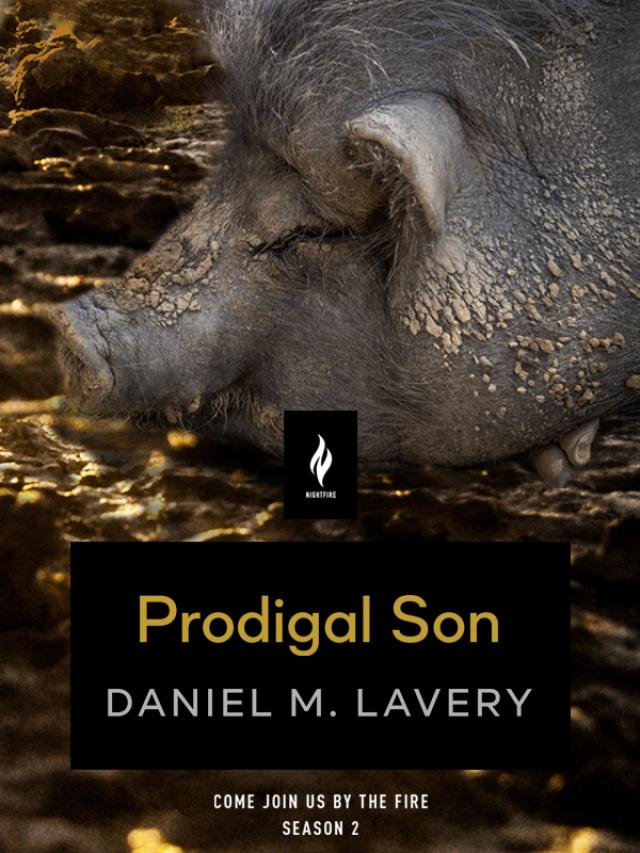
Art copyright © 2021 by Grant Durr (pig) and Daniel Sturgess (mud)
Daniel M. Lavery, Prodigal Son
Thanks for reading the books on GrayCity.Net






