Grey zone, p.1
Grey Zone, page 1


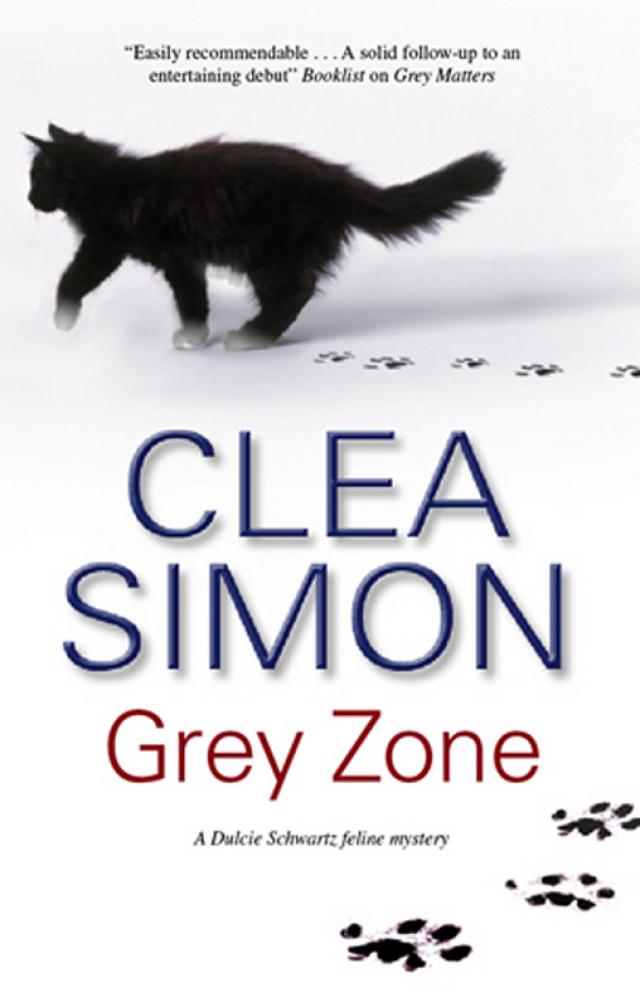
Table of Contents
Cover
A Selection of Recent Titles by Clea Simon
Title Page
Copyright
Dedication
Acknowledgments
Chapter One
Chapter Two
Chapter Three
Chapter Four
Chapter Five
Chapter Six
Chapter Seven
Chapter Eight
Chapter Nine
Chapter Ten
Chapter Eleven
Chapter Twelve
Chapter Thirteen
Chapter Fourteen
Chapter Fifteen
Chapter Sixteen
Chapter Seventeen
Chapter Eighteen
Chapter Nineteen
Chapter Twenty
Chapter Twenty-One
Chapter Twenty-Two
Chapter Twenty-Three
Chapter Twenty-Four
Chapter Twenty-Five
Chapter Twenty-Six
Chapter Twenty-Seven
Chapter Twenty-Eight
Chapter Twenty-Nine
Chapter Thirty
Chapter Thirty-One
Chapter Thirty-Two
Chapter Thirty-Three
Chapter Thirty-Four
Chapter Thirty-Five
Chapter Thirty-Six
Chapter Thirty-Seven
Chapter Thirty-Eight
Chapter Thirty-Nine
Chapter Forty
Chapter Forty-One
Chapter Forty-Two
Chapter Forty-Three
Chapter Forty-Four
Chapter Forty-Five
Chapter Forty-Six
Chapter Forty-Seven
Chapter Forty-Eight
Chapter Forty-Nine
A Selection of Recent Titles by Clea Simon
CATTERY ROW
CRIES AND WHISKERS
MEW IS FOR MURDER
SHADES OF GREY*
GREY MATTERS*
*available from Severn House
GREY ZONE
A Dulcie Schwartz mystery
Clea Simon
This ebook is copyright material and must not be copied, reproduced, transferred, distributed, leased, licensed or publicly performed or used in any way except as specifically permitted in writing by the publishers, as allowed under the terms and conditions under which it was purchased or as strictly permitted by applicable copyright law. Any unauthorised distribution or use of this text may be a direct infringement of the author's and publisher's rights and those responsible may be liable in law accordingly.
First world edition published 2010
in Great Britain and in 2011 in the USA by
SEVERN HOUSE PUBLISHERS LTD of
9–15 High Street, Sutton, Surrey, England, SM1 1DF.
Copyright © 2010 by Clea Simon.
All rights reserved.
The moral right of the author has been asserted.
British Library Cataloguing in Publication Data
Simon, Clea.
Grey zone. – (Dulcie Schwartz feline mystery)
1. Women graduate students–Fiction. 2. Animal ghosts–
Fiction. 3. College teachers–Crimes against–Fiction.
4. Detective and mystery stories.
I. Title II. Series
813.6-dc22
ISBN-13: 978-1-78010-245-0 (ePub)
ISBN-13: 978-0-7278-6992-0 (cased)
ISBN-13: 978-1-84751-324-3 (trade paper)
Except where actual historical events and characters are being described for the storyline of this novel, all situations in this publication are fictitious and any resemblance to living persons is purely coincidental.
This ebook produced by
Palimpsest Book Production Limited,
Falkirk, Stirlingshire, Scotland.
For Jon
ACKNOWLEDGMENTS
Books may be written in solitude, but they are best revised in company and Dulcie has had the benefits of a wonderful crew. This is a work of fiction; neither these crimes nor many of these places (including the Poche Building) exist, but lots of kind people have helped me flesh out what is pure fantasy. Forensic specialists and fellow crime novelists Doug P. Lyle MD and Lee Lofland both shared their extensive (and bloody) expertise, as did Detective Charlotte Dana Rowsey of the Charlotte (WV) Crime Scene Unit, police investigator Dan Christman, and several of their colleagues in the Yahoo bloodstains and patterns group. I learned far more than I got to use, but I am most grateful for your time. Dan Riviello, communications specialist for the Cambridge (MA) Police, helped track down answers when he didn’t have them immediately to hand – and didn’t laugh. My fearless readers – Chris Mesarch, Brett Milano, Naomi Yang, Michelle Jaeger, Lisa Susser, Karen Schlosberg, and Jon S. Garelick – gave me time, feedback, great comments, and tons of support. Wonder editor Rachel Simpson Hutchens’ eagle eyes saved me from embarrassment. My agent Colleen Mohyde and editor Amanda Stewart have believed in Dulcie from the start and been just unfailingly wonderful. And Jon, well, without you . . .
ONE
Writing, writing furiously, she pushes back her long, loose curls, heedless of the ink that smudges her pale cheek. Heedless, too, of the sparks that scatter, each time the fire pops and hisses in response to the storm outside. Rain and wind hurl themselves at the window, dashing against its many panes and finding their way down the old chimney, their mission carried through by smoke and crackle, by tumbling embers. They want her out; they want her gone. Still she scribbles, but time itself runs short, snatched away by the fury outside. The storm that floods o’er all. One line – one phrase to make her case. ‘Such noisome beasts as do attack . . .’ No, she scratches it out. ‘The pernicious spirit . . .’ Not that, either. If only she had time. The thunder cracks the night, and the sparks fly. Two hover, glowing an unearthly emerald green and growing into almond-shaped eyes. Cat’s eyes, staring . . .
They want her dead.
‘You’ve got murder on the mind.’
The disembodied voice could have been miles away. In front of her, the kitten blinked, and Dulcie, thinking of her dream, found herself drawn into those glowing eyes, unable to decide if they were more yellow or green. Unable, as well, to block out the terror she had felt early that morning when she had woken, gasping, in the dark. Hours later, the horror still lingered, chilling her like a draft. Or the presence of a ghost.
But the voice persisted. ‘You do, you know. Murder.’
Chris, Dulcie’s boyfriend, was on the phone. It was almost noon, a workaday Monday. The wisps of the dream should have faded as Dulcie sat at her desk with a pile of student papers before her. But while the sun, for now, shone brightly and purposefully through the window, and though her sweetie sounded equally intent, Dulcie couldn’t be dissuaded.
‘I don’t simply have “murder on the mind,” Chris.’ A doctoral candidate in English literature, Dulcie considered herself an expert with words, and this inability to explain her suspicion was frustrating. ‘I just know something happened.’
In the light of day, sitting in the cozy, albeit slightly shabby, apartment she shared with her best friend Suze, it did seem silly. Maybe that’s why she hadn’t told Chris about her nightmare right away.
It didn’t help that he wasn’t there. Not that she could blame him. Ever since the spring semester had geared up, her computer geek boyfriend had been hard at work, picking up the overnight shifts that paid the most, even when they conflicted with the Red Sox preseason. With the onset of midterms, two weeks earlier, he’d been stuck in the Science Center basement almost every night, helping clueless undergrads with their programs. He needed the money, she knew that. Living on grants and student loans like most grad students, they were both struggling to pay their bills.
Dulcie had a full schedule, too: wrangling freshmen through English 10 and tutoring several upperclassmen one on one. These days, she barely found time to work on her own thesis, a study of an obscure Gothic novelist – and, if her suspicions were true, possible victim of some kind of crime. Their romance, she realized, was paying the price.
Besides, she would never be able to describe how scary the dream had felt. How real. Chris might love her, but he was a computer guy. A mathematician. He’d taken a lot on faith from Dulcie, but she knew she’d be on more solid ground detailing her suspicions in scholarly terms, without reference to her strange and troubling dream. If only she could do that.
Trouble with her thesis she was used to. But trouble talking to her boyfriend? Dulcie felt uncharacteristically tongue-tied.
‘I believe you, honey.’ Chris was trying, she could tell. ‘But I’m not on your thesis review board. And you do sound kind of obsessed over what is basically a hunch.’
As if on cue, the kitten jumped to the desk, reaching one white paw for Dulcie’s red pencil. ‘No,’ said Dulcie to both members of her audience, clear at last. ‘It is more than a hunch, Chris.’ She could stick with what she could prove and still make her point. She was Dulcie Schwartz, soon-to-be PhD. ‘You don’t know the history of this woman like I do. The writing. The work.’
Dulcie looked over at her bookcase: five collections of Gothic literature, their battered black spines as familiar as Chris’s face. A library book of essays, soon to be overdue. And her copy of The Ravages of Umbria, its fanciful title set off in gold ornate type, with the single credit, Anonymous, just a little smaller.
‘Nobody knows her name,’ Dulcie continued. ‘But I know her writing style as well as my own, and th ere are signs of her all over the canon. Repeated phrases, specific images so distinctive they have to be from the same writer. They show up in essays, letters, as well as the fragments of her novel, all going up until about 1794. And then, nothing. No, Chris, I have my reasons. There must have been a threat or pressure. Something nefarious. People like her do not just disappear because of natural causes.’
‘Maybe she didn’t disappear.’
Dulcie swallowed what she was about to say. Had he had the same dream?
But, no. True to his discipline, Chris was trying to be rational. ‘Maybe your so-called victim simply stopped writing,’ he was saying. ‘Had kids. Retired to the country. It happens. Maybe—’ He paused. ‘She died. I mean, health care wasn’t the greatest in her day, right?’
‘But, Chris, obituaries – at least death notices – were fairly common by then. I’ve scoured the papers, hoping to see some mention of The Ravages. Maybe find out her name. And there’s nothing, not even a remembrance, of any “she-author” or “lady of letters.”’ Dulcie began summarizing her research for Chris. Waving her pencil in the air as she talked, she cited paper after paper, their dates stuck in her mind like cat claws in velvet, until the kitten interrupted, reaching up to bat at the pencil’s eraser. Kitten? Esmé, the one-time foster she’d adopted, was looking more and more like a cat every day. But not, she thought with a twinge of sadness, any more like her old cat, Mr Grey. ‘She’s just gone,’ said Dulcie, ceding the pencil to her pet.
‘Well, it’s not like you can call the police, Dulcie.’ Chris sounded tired. He’d never tell her, but she suspected that her call had woken him up. With his hours, that was always a risk.
‘I know; it’s just preying on me.’ She should have told Chris about her nightmare right away. She should have trusted him to have faith in her. Maybe, she realized, she didn’t entirely believe in the power of her vision.
‘I can’t help but think something was going on.’ The feeling had begun to fade. Her boyfriend, daylight . . . the kitten. But then the image of a woman, writing for her life, flashed before her. ‘Something besides kids, or an early retirement, or— or some sudden illness.’
As Dulcie talked, the certainty grew. ‘My author was silenced, Chris, and I’m going to get to the bottom of it. Even if I am two hundred years too late.’ With that, she reached for her pencil, ready to get back to work. But the kitten was having none of it and nipped her outstretched hand, before knocking the pencil to the floor and darting away.
TWO
Dulcie was still thinking about the missing author as she left for campus. She wasn’t sure who the woman in her dream had been, she realized as she locked the door, slipping her keys into her pocket. After all, she didn’t have a name for the author she was studying, much less a portrait. But even as she made her way down the front steps and on to the sidewalk, she couldn’t shake off the sense of dread the nightmare had carried. Dread, but also purpose. Something was amiss; someone had wished the mysterious woman ill, and Dulcie couldn’t help tying that strange moody feeling of impending danger to the scholarly mystery before her.
She bent into the wind as she made her way along the busy Cambridge street. The bright midday sun had disappeared into more typical March clouds, but the weather only served to make Dulcie more determined. Abandon’d there upon her windswept peak, plagued by the vengeful spirits . . .The writer who could pen that didn’t simply stop writing. Someone was plotting trouble – or had been.
Chris was right, of course. If there had been some kind of malfeasance, it was way beyond the jurisdiction of the authorities. Even beyond the reach of the university. Dulcie paused in a convenience store doorway. Harvard was only about a mile from the apartment, but on a blustery day like today, the easy walk became a trek. What if she had been abandoned on a windswept peak? A woman alone on a mountainside, desperate and reliant on her will alone . . .
It was no use. She couldn’t distract herself, not even with one of her usual fantasies. The dream loomed too large in her mind. Just such a craggy scenario had figured prominently in The Ravages of Umbria, the novel Dulcie was studying – the one major work her unnamed subject had left behind. Before she had disappeared. Before . . .
There was nothing she could do. Not from Massachusetts. The woman Dulcie was worried about had been British. A writer whose name had been lost to history, and who – foul play or no – would have been long dead by this century anyway. But Dulcie felt the impact of the crime as if it were personal. The missing author was more than an academic footnote, or even the subject of her thesis. Ever since she’d read the remaining fragments of The Ravages of Umbria, Dulcie had been taken with the unknown author’s colorful phrases and smart arguments. A tale of heroism, of a lone woman who had to fend for herself in a haunted castle, it had won Dulcie’s mind as well as her fancy.
Hermetria had been a woman she could relate to. Strong, smart. Alone but for her companion Demetria, a noblewoman of good family, whose fortunes had fallen prey to evil times, she would gaze over the majestic peaks, whose summits, veiled with clouds, revealed at times their jagged teeth . . .
There were ghosts, of course, but the story had so much more. And where others had dismissed the little-known Gothic as supernatural fluff, Dulcie had found wisdom. In the dialogue between the main characters, she had spied a smart dramatization of ideas – the kind of ideas that got women in trouble in the eighteenth century. Since that first discovery, she’d unearthed several essays, too: more blatantly political works. It was heady stuff for a scholar of Gothic fiction. Whoever she was, the unknown author had been a groundbreaking thinker, one of the first proponents of women’s rights. And then she was gone.
It was a problem Dulcie was still wrestling with as she passed by the small, modern building that housed Middle European Studies. Hunched like an orange hillock, the strangely rounded building made Dulcie long for the soaring stone turrets described so well in The Ravages. At least they had some kind of grandeur. This orange lump had none and had already been eclipsed for novelty. A few blocks away, just visible over its sherbet-colored roof, stood this year’s architectural wonder, the Poche Building: seven stories of developmental psych. New to the skyline, it had already won the sobriquet of ‘Porches’, for the tiny but decorative balconies that broke up its glass and steel facade. But if the encircling railings – smaller than the average fire escape – were supposed to make the building look more welcoming, they failed. Dulcie had grown up without many modern conveniences, but she could never look at those rails without thinking of braces on so many teeth. The effect was humorous and made her fonder of the building than of most of the university’s other modern attempts, and more accepting of it than many of her peers.
As she approached the small clapboard house that served as home to her own department, she was reminded of why not many of her colleagues shared her view. Gray, with white trim, the English and American Literature and Language office might not have Gothic grandeur, but it looked cozy and welcoming. So unlike the newer buildings that towered over much of the rest of the Square. As if on cue, the sun broke through again, lighting up the trim and glossy black shutters. And, just as suddenly, the scene before her darkened. Although Dulcie did not subscribe to the theory that the placement was intentional – another blow in the continuing war between social sciences and humanities – there was no doubt of the effect. After more than a century of enjoying the afternoon sun, the little clapboard house was literally eclipsed as the shadow from the Poche cast its gray sides into a gloom the author of The Ravages would have recognized.
With a sigh, Dulcie turned into the little clapboard. She had a meeting with her new thesis adviser, Norm Chelowski. Soon he’d have to file his first report on how his new doctoral candidate was doing, and while Dulcie didn’t usually cast herself in the role of beleaguered heroine, she feared he would not be impressed with her progress.
‘Hi, Nancy.’
The departmental secretary, a warm, motherly sort, looked up from her keyboard and smiled. ‘He’s waiting.’ She mouthed the words. ‘Good luck.’
Swallowing, despite the sudden dryness in her mouth, Dulcie took the old stairs two at a time, skipping over the cracked one second from the top. Maybe the department had been shorted on funding.