Hackenfellers ape faber.., p.1
Hackenfeller's Ape (Faber Editions), page 1
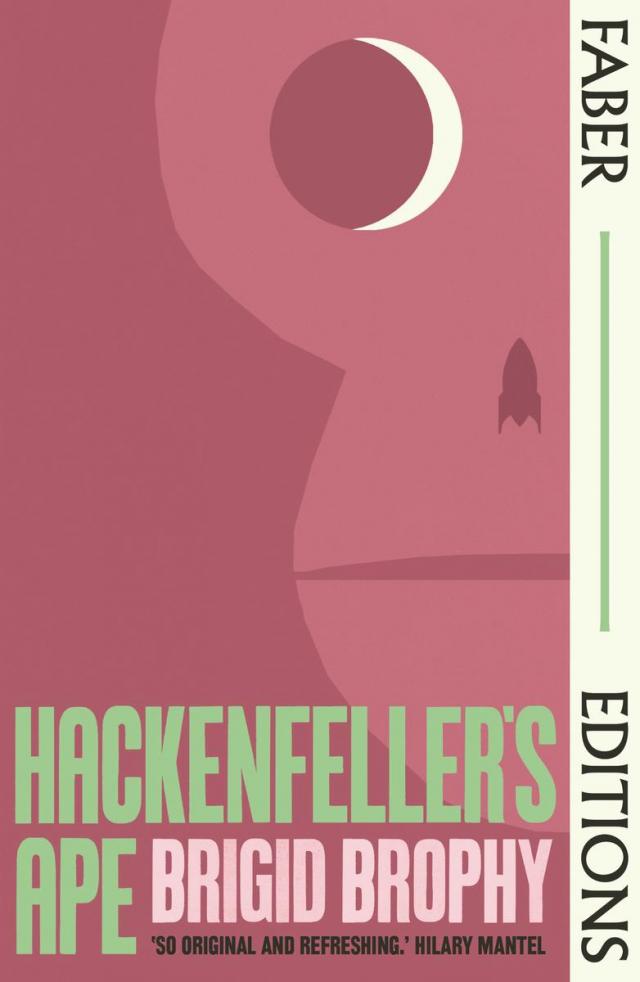


HACKENFELLER’S APE
Brigid Brophy
In April 1991 Hackenfeller’s Ape, my first novel, proved to be prophetic. After I was sent down (expelled from Oxford University), I shared a flat in North London with a friend, from which we heard the lions roaring from London Zoo. That redoubled my hatred of zoos.
Brigid Brophy, 1991
All the characters in this novel are fictitious;
so is the species Hackenfeller’s Ape,
but not the species Homo sapiens
Contents
Title Page
Author’s note
Epigraph
Foreword
1. Predicament of an Ape
Sunday
Monday
Tuesday
2. Escapade of a Professor
The Night, Tuesday–Wednesday
Wednesday: Sunrise
Wednesday Morning
3. Soliloquy of an Embryo
Easter, The Following Year
About the Authors
Also in Faber Editions
Copyright
Foreword
by Sarah Hall
In our current era of environmental activism – an era of disruptor groups, royal ivory shaming and scrutinised farming methods – it’s right to remember that there were radical agitators at work in the 1950s. Such was Brigid Brophy – author, intellectual, polemicist and social reformer. Brophy was, during the mid-twentieth century, at the forefront of humanitarian and animal rights campaigns; she may be regarded as an initiator of the latter. Seventy years on, Hackenfeller’s Ape, her debut novel about human–animal relations, is still a red-edged, societally exposing and wincingly satirical text. The compass at the book’s heart aligns no less with today’s moral philosophy – if anything, it clarifies the murkier, inconsistent issues around treatment of animals and human privilege, our so-called supremacy and ingenuity at the expense of other species.
In the fifties, Brophy’s leading literary contemporaries were inventing carnivorous plants, virally killing off grass and opening portals in wardrobes – engaging with broadscale post-apocalyptic scenarios and fantasy worlds. Meanwhile, Brophy grounded her imaginative powers in live terrestrial issues, what we might now term Anthropocene and Homogenocene concerns, albeit including playful elements of science fiction. This was a period of high subspace exploration, with capsules being trialled by macaques and chimpanzees in order to measure biological effects and stress, and therefore assess human astronaut safety. Central to the novel is an enquiry into the impact of man on other animals, especially those closest to us on nature’s chart, even as he considers himself to be engaged with progress. Brophy shakes the tree, quite forcefully. She questions free will, rights and entitlement. She questions our motives. Our governance. Our justifications for collateral damage. She highlights dissonance in the Age of Cain, when, as the story’s Co-ordinator of Scientific Studies casually remarks, ‘The more consciousness any culture has, the more it enjoys cruelty.’
It’s a deft and damning book. Its components are slick and simple, the story propulsive. An ape in London Zoo, bought from its private owner and earmarked for a dreadful mission. An unlikely, hapless liberator. A race against time and launchable skies. Government machinations. Rogue agents. Hackenfeller’s Ape, as well as being an enormously thrilling, at times rollicking read, constitutes a rigorous exploration of power and usury within environmental and political theatres. Fittingly for a novel of fewer than 150 pages, the cast of characters is slim. The opera-loving, anthropomorphism-flirting zoologist, Professor Darrelhyde. Kendrick, a brash, ambitious representative from the classified rocket project. Pickpocketing Gloria, the professor’s wonderfully subversive accomplice. A handful of practically useless but contextually helpful minor characters. And, of course, the novel’s alternative – or perhaps true – hero and heroine: Percy and Edwina. The sombre-faced, incarcerated apes, trophies from Africa, fictitiously higher up the evolutionary ladder than any of their monkey cousins, whose non-existent mating habits the professor is studying.
From the book’s disclaimer on, there’s a spry and teasing humour. Brophy has clearly observed and cleverly noted social structures and behaviours. The narrative perspective is that of a delighted and disappointed naturalist, whose eye is cast not only over the displaced, cognitively grasping primates in their concrete enclosure, but over her own marvellous, cavorting, calculating species. The tone is distinctly original, quick with wit, but also chastising; a tale rising from an amused and vexed field researcher’s notebook.
For while the apes scratch their bottoms, snatch proffered apples and try to comprehend comments about Mozart, the humans are more absurd still: opinionated within their compassions, self-defeating and tragically divisive. The reader is never sure who is funnier or more pitiable: we dysfunctional but inventive humans, or the frustrated, lovelorn apes. Both beings are zoo-ish when put on display. Both are scrutinised anthropologically and ruthlessly by Brophy – in ritual (or lack thereof) desires, egos and failings. The reader is repeatedly encouraged to ask, which biological machine is most sympathetic or silly? Which needs enlightening and rescuing from its mode of being and way of thinking – and from its final destiny? We are, on occasion, so closely drawn, so almost the same; the professor and Percy communicate imperfectly and touch hands though the bars.
In the end, the reader is not quite sure whether man is in a monkey suit, or if the monkeys have attained some humane quality. Alongside the author’s advocacy work, the message in her fiction is clear – that in exploiting our environment and our fellow, feeling species, we ultimately damage ourselves, physically as well as psychologically.
The novel is truly gorgeous and playfully accusatory: rude, respectful and hilarious. It remains a superbly wrong-footing and liberal work of fiction, as full of vim and as politically on point as it was when the first primates were helmeted, strapped into pods and thrust away from the earth’s atmosphere, in the name of human advancement.
But the story is not purely negative or without hope – ebbing as it is in our age of catastrophic loss of biodiversity and rapacious capitalism, hope being quite desperately sought. In Hackenfeller’s Ape, nature has the last word. Nature regenerates and asserts itself, powerfully, while men panic and seek instruction about life’s operation code. The book certainly isn’t a tonic in our times – Brophy was not in the business of literary consolations. Her professor is all too aware of the potential for planetary ruin and extinction, telling Edwina: ‘When my species has destroyed itself, we may need yours to start it all again.’ This provocation stands now, of course, as humanity rushes headlong towards climate peril and uncertain prolongation. And while we may not be assisted on the brink by smarter apes or by any other animal, having savagely denuded their numbers and their habitats, we might wonder, with a wry, Brophy-esque smile, which tenacious, adapted creatures will survive us?
hackenfeller’s ape
1
Predicament of an Ape
Sunday
Radiant and full-leafed, the Park was alive with the murmuring vibration of the species which made it its preserve. The creatures, putting off timidity at the same time as winter drabness, abounded now with no ascertainable purpose except to sun themselves. Their seasonal brilliance – scarlet, sky-blue, yellow – interspersed the deep, high-summer greenness of the foliage. The ground, too hard to receive their spoors, shook beneath games that revealed a high degree of social organization. Elsewhere the grass lay folded back, shewing where solitaries of the race had eased themselves into forms. On the gravel paths, scuffles and hoots gave evidence of courting rites; and in every part the characteristic calls of the kind lay clear and pleasant upon the vivid air.
In the central meadow they were playing cricket. Westward, the shouts and splashes of the boating lake lingered, like gentle explosions, above the expanse of shallow water. North-west, the canal stood black and transparent like indian ink, between banks mottled by sun. Once or twice a day a boat slowly passed, silencing the fish in their continual scratching of the surface, and propelling towards the sides tangible hanks of water, curled into wreaths, braids and pigtails. North of the Park, a tarmac road had been laid over the landscape. At all times it was arid; this weather made it torrid. A row of cars was already here, standing outside a wire-bound entrance which led to the only section of the Park that could not be enjoyed free. The bodywork of the cars was scorching. Their windscreens threw off, at a squinting angle, dazzling blots of light. Some belonged to people privileged to go in when the general public was excluded and who were at this moment inside. Others belonged to members of the public who, misinformed, had come too early; who had been refused at the turnstiles; who now had to fill in time and eat their parcelled luncheons elsewhere. The children were the most resentful of the contretemps, sulky because their parents had proved not to be omnipotent. They resisted as they were pulled away: to gain time, they gazed upward as they went, pretending they could not walk straight, staring at an aeroplane that was doubling to and fro in the sky.
These were the young of a species which had laid out the Park with an ingenuity that outstripped the beaver’s; which, already the most dextrous of the land animals, had acquired greater endurance under the sea than the whale and in the air had a lower casualty rate for its journeys than migrating birds. This was, moreover, the only species which imprisoned other species not for any motive of economic parasitism but for the dispassionate pa
That curiosity, however, was not to be indulged on Sunday before half past two. The adults pulled the children on, past street vendors of orangeade and sticky bags of plums, who were already waiting for the crowds to arrive in earnest. Two or three old men, hoping to capitalize the guilt the adults must feel in denying the children, dangled dirty woollen caricatures of dogs and lambs on the end of a string, or thrust upon the mothers toy windmills with violently-coloured plastic sails, which there was no wind to turn.
It was a hot, flawless Sunday early in September.
Within the enclosure, Professor Clement Darrelhyde sat on an iron bench, quietly singing the Countess’s cavatina from the second act of Figaro’s Marriage.
‘Porgi, amor, qualche ristoro
Al mio duolo, a’ miei sospir!
O mi rendi il mio tesoro
O mi lascia almen morir!’
A soprano aria: so he sang falsetto. His voice was true but spindly, rather like a harpsichord; which made it almost exactly in period.
‘Grant, O Love, some recompense
To my sorrow, to my sighs!’
He sang to the accompaniment of an aeroplane’s noise, miles above, and for a moment he craned up to watch the vapour trail deposited on the sky. Perfect cricketing weather, perfect boating weather, this was also perfect flying weather. The Professor admired aeronautics, with its vapour trails and parachutes, and its discovery of cloudscape seen from above; the only achievement of his own century which he would compare with Mozart’s music.
He brought his nose down and flattened out, resuming the vigil he kept over the opposite side of the path. There were few passers-by to cut off his vision, and none of them noticed him or the womanish noise he was uttering. They came bounding along, absorbed in their own energies and sense of privilege. They scrutinized the outlandish scene at large, anxious to miss none of its wonders, questing for creatures more melodramatic than the Professor.
He was here on business – observation. What he had come to observe, however, and had fully expected to observe every day for three weeks, was not happening. Meanwhile, he sang.
He enjoyed the sunshine on his face and the patterns of the hot white dust at his feet.
The persistence of the aeroplane’s noise, however, reminded him of an uneasiness in himself. Uneasiness seemed to be the background of all ruminations belonging to the twentieth century, just as all its landscapes were presided over, somewhere in the distance, by an aeroplane. The beauty of the flying machine was neutral. Carrying bombs or peace it left the choice, almost belligerently, to Man.
‘Either restore to me my treasure
Or let me at least die.’
Beneath all the blooming and splendid scents of this most assured time of year, there was another which reached the Professor: an odour shabby, seedy, somehow disgraceful: the smell of the caged animals.
Something moved on the far side of the path. The Professor sprang up, and approached the cage.
A false alarm. The male monkey, with that disregard of his own dignity which, rather than his physical appearance, marked him as non-human, had stood up to scratch his buttocks and then once more squatted down on them. Nothing else had changed. The two animals were still at opposite sides of their small cage, still unmoving, presenting to one another a disgruntled three-quarters profile.
In irritation, the Professor tapped the metal label fixed on the bars.
HACKENFELLER’S APE
Anthropopithecus Hirsutus Africanus
♂ ♀
Percy and Edwina
Hackenfeller had been (the Professor half knew, half assumed) a sober Dutchman who, exploring into Central Africa some time during the nineteenth century, had come upon a species not previously recorded. It was the same size as the gorilla, but in appearance and character nearer the chimpanzee. In captivity it moved on all fours; but in the jungle, as Hackenfeller had noted, it ran erect with its hands holding on to branches overhead. Children sometimes used a similar method when they learned to walk, but in the adult man it was forgotten until he had to relearn it in crowded buses and trains.
In Central Africa Hackenfeller’s Ape was not rare, and not difficult to take alive. Almost any pretty and succulent fruit would lure it into a trap. In Europe it thrived but seldom mated. Any collector who wanted a pair of the apes had to incur the expense of sending for them south of the Equator. Accordingly there was only one cage here labelled ‘Hackenfeller’s Ape’: and this label, with a few like it in other zoos, was perhaps the Dutchman’s only memorial on the face of the earth – unless in some jungle clearing the largest of a few decaying huts still bore, scarcely legible, whatever the Dutch was for ‘Hackenfeller’s Mission’ or ‘Hackenfeller’s Medical Institute’.
After Hackenfeller had come London zoologists of the Professor’s own kind. Working on specimens alive and dead, they had established that the eyesight of Hackenfeller’s Ape, and the composition, temperature and pressure of its blood, came closer to the human model than those of any other animal. They had allotted to the species its place in the Evolutionary progress, and had devised its Latin name. One of them had inadvertently graced it with the proudest of old Roman titles: and knocking on the metal plate, gazing into the concrete cage, flooded yellow by the sun, the Professor felt a plumed and helmeted shadow fall across his mind at the memory of Scipio Africanus.
Ducking under the barrier which stood a foot or so from the cage, he approached so near that nothing but bars divided him from the animals. There they sat, ♂ and ♀, forced by their confinement into a resentful communion. If the Chimpanzees’ Tea Party, which sometimes took place on a nearby lawn, was a rollicking caricature of human social life, here was a satire on human marriage. Separated by the yard or two that was the extent of their cage, not looking at one another, tensed, and huffy, Percy and Edwina might have been sitting at a breakfast table.
Perhaps apprehension of something like this had prevented the Professor himself from marrying: though he had never been assured that the woman existed who would have taken him.
‘Porgi, amor …’
he sang sadly, and was transported into another era, another sex.
He became the middle-aged Countess, tragically and with dignity calling on Love to restore her treasure – the affections of her Count. His voice did duty for a full, womanly voice: his scraggy body stepped into the body of a mature soprano – a body so magnificently weighted down that all its actions must be performed slowly, graciously and with stately mien. Was not this stagecraft? Turning the cumbrousness of ripe sopranos to dramatic advantage, Mozart had made his Countess tragic in the very fact that her waist was thickening while her hands remained tiny and manicured, and in the very fact that she could not compete, for the Count, with her own serving maid. Out of the strutting gait of fat-bellied bassi Mozart had created Figaro: conceited, pragmatic, a man with an air to him. To accompany the strut he had written the martial bars that rounded off Non Più Andrai: and when, the Professor wondered, in all human existence had the curtain of a first act come down on such ringing exhilaration as Non Più Andrai and the curtain of a second act risen on such tenderness as Porgi Amor?
Irritated again, he tapped the label again, this time using Figaro’s own rhythm. For the world did not do Mozart justice. Day by day people saw his charm, and missed his depth, his grandeur, his religion. They belittled him as a light composer, and praised such shallow things as—
‘Rossini!’ the Professor cried aloud, in contemptuous comparison.
The male monkey turned his face upward, sympathizing with the Professor’s indignation, although he did not understand its cause. Indeed, he was half worried lest he himself had offended. The female monkey only stared at the Professor. If he felt indignation, she was pleased. If it could have entered her mind that she had caused it, she would be more pleased still.