The beast ss, p.1
The Beast (ss), page 1


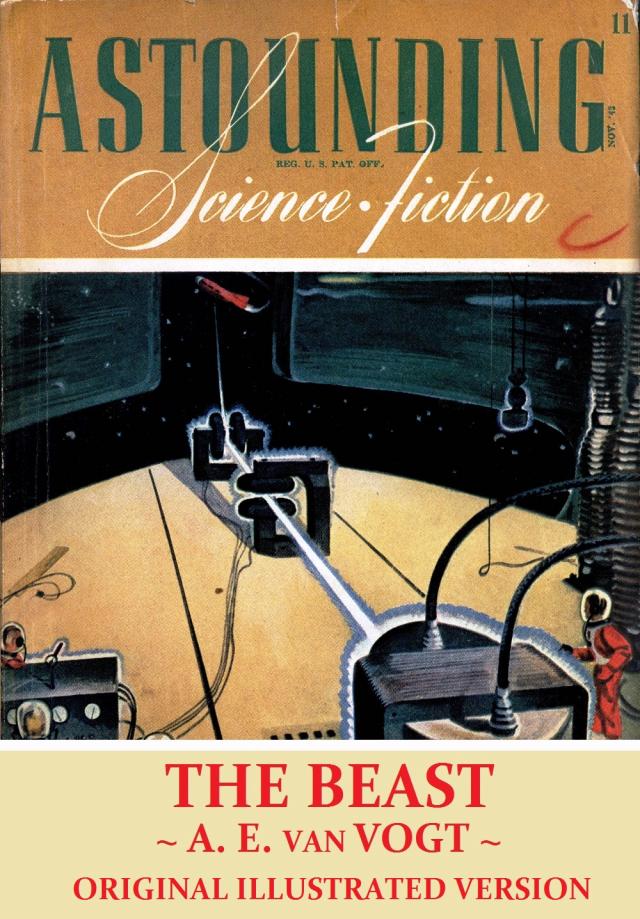
The
Beast
by A. B. van Vogt
Illustrated by Orban
Given time, even a fumble-witted Neanderthal could learn to be a sly and deadly oponent. And the Beast had had time— and was master over a long-forgotten power—
From Astounding Science Fiction November 1943 edition
The
Beast
by A. B. van Vogt
Illustrated by Orban
Given time, even a fumble-witted Neanderthal could learn to be a sly and deadly oponent. And the Beast had had time—and was master over a long-forgotten power—
Pendrake passed under the corner archway of the drugstore, emerged onto Fiftieth Street—and stopped short.
The twin aërogel towers across the street looked strangely bare and different. Pendrake stared blankly for a moment before he saw what was wrong: The plasto-glitter sign was gone, the sign that had read:
CYRUS LAMBTON
LAND SETTLEMENT PROJECT
Slightly more than two years had passed since that day in August,
1948, when he had found an atomic engine in the hillside near Crescent-ville, slightly less than two years since he had traced the marvelous machine to these turreted towers and to a group of scientists who were secretly operating spaceships to Venus, carrying emigrants to that fantastically lovely and fertile planet under an idealistic plan of their own.
Three times he had been to Venus himself after Eleanor and he resumed their badly shattered married life. But now for nearly a year Eleanor had required constant attention.
The baby was born dead. Eleanor in her intense fashion was still taking it hard; and the doctor advised a change of scene. What better place than Venus: so here he was to make the arrangements. Funny if the scientists had suspended emigration to that glorious planet without advising him. From the moment of discovery they had treated him as one of themselves.
Frowning, Pendrake crossed the street and peered through the window. But the smaller sign that had once graced its interior, giving accurate yet carefully worded details to prospective emigrants—that sign was gone, too.
Beyond the window frame, considerably beyond, a woman sat at a desk. Her back was to him, but one glance showed that she was not Mona Grayson, the daughter of the inventor of the atomic engine.
Mona Grayson had been small, slight of build. This woman was broad in every beam right down to her thick ankles.
Shrugging, Pendrake went to the door. It opened at the barest touch of that strong hand of his.
“Bin dere anyting you vant?”
The broad German accent was like a slap in the face. Pendrake halted, then slowly walked around to the front of the woman’s desk. He stood there staring at her.
She had a plump face, dark hair, dark eyes; and after a moment the very grossness of her appearance, the very unvarnished quality of her guttural, broken English brought easement to his strained nerves.
She might be Jewish; and besides, what the devil, anyway? There had been plenty of refugee scientists and their families. For all he knew, this was a member of such a family. He caught himself.
“Is Dr. Grayson in?”
“Vot name shall I gif?”
Pendrake winced. “Pendrake,” he said grudgingly. “Jim Pendrake.”
“Vrom vere?”
Pendrake made ah impatient gesture with his single arm toward the closed door that led to the other tower. “Is he in there?”
“I vill send your name in if you vill tell me vere you are vrom I Mr. Birdman vill explain everyt’ing to you.”
“Mr. what?”
“Vun moment, und I vill call him.”
Pendrake tensed. There was something wrong, just what, wasn’t clear. And this comic-opera caricature of an information girl wasn’t helping matters. For some reason Grayson and the others had given up these towers as a center of interplanetary activity, and a bunch of Germans had taken over the building.
He looked up with abrupt decision. “Don’t bother to call anyone. I can see I’ve made a mistake. I—”
He paused, closed his eyes, then opened them again. The pearl-handled revolver was still peering at him over the edge of the woman’s desk.
“If you make vun moof,” she said, “I vill shoot you mit dis noiseless gun.”
A stocky man came into view. He had sandy hair, and freckles; his gaze played swiftly over Pen-drake, lingered momentarily on the latter’s empty right sleeve, then he said softly in perfectly colloquial American:
“Good work, Lena. I was just beginning to think we’d gathered up all the threads, and now here comes another. We’ll put him in a spacesuit, ship him by truck to Field A. There’s a plane due there in half an hour. We can quiz him later on. He must have a wife and maybe some friends—’*After an hour, the horrible, jarring ride was over; the chains were taken off the suit that inclosed Pendrake. As he sat up dizzily, he saw a house and other buildings, and standing among them a small cabin-model, propellerless plane.
One of the truckmen motioned with a gun. “Get over there.” Three men were in the plane. They wore the same kind of metal-plastic suits as Pendrake had, and they said nothing as he was pushed aboard.
One of them indicated a seat; the man at the controls pushed a lever and, soundlessly, the machine began to move forward—and up. The utter silence of the immensely potent movement was all Pendrake needed. Here was a Grayson atomic engine.
With startling suddenness the sky grew dark-blue. The sun lost its roundness and became a shape of flaring fire in a universe of night.
Behind the plane the Earth began to show its roundness. Ahead glittered a growing orb of moon.
The phone lights misted: “Bird-man speaking, excellency.”
The ice-cold voice at the other end said: “You will be glad to know that after only three days we have all the necessary data on the man, Pendrake. As you know, it is imperative that we locate for questioning every person who might have some knowledge of the Grayson atomic engine, and do so without creating the slightest suspicion against ourselves. You will, therefore, carry out the following orders with respect to Mrs. Grayson—” The misty light faded slowly; and the stocky Birdman shook himself like an animal coming in out of drenching rain.
He walked swiftly to a cabinet in one comer of his office. It opened at his touch. Liquor bottles gleamed at him. Almost without looking he snatched one, and poured himself a glass of amber stuff—drained it at a gulp.
He shuddered as the violent concoction billowed inside him, and then slowly he returned to his desk. Funny, he thought, how the sound of his voice always affected him so strongly.
II.
MANIAC KILLS SERVANTS, KIDNAPS WIFE. EX-AIRMAN JAMES PENDRAKE SLAYS FIVE. IS DRAMATICALLY ACCUSED IN NOTE WRITTEN BY DEAD SERVANT.
Crescentville, Aug. 23—In a dramatic note, written by a maid servant as she lay dying, James Pendrake, one-armed former airman and husband of Eleanor Pendrake, was accused of murder and kidnaping. The story of the only other witness to the crime, Major Ned Hoskins, Washington patent attorney and friend of the Pendrakes, has not yet been released by Air Force authorities who—
“Major Hoskins,” said the Air Force officer presiding, “just how far were you from the white house on the Pendrake estate when you first noticed something wrong?”
“About two hundred yards,” Hoskins said quietly.
“Under what circumstances were you there,”
“I had received a most confused phone call from Mrs. Pendrake. Her husband had been away three days without calling her, and her calls to his hotel in New York had produced the information that he hadn’t been in his room since the day of his arrival.
“She then, she informed me, called up several friends and—this is where my confusion comes in—the people involved were all dead or missing. She babbled something about an atomic engine, and an organization that was transporting emigrants to Venus.”
“She was quite hysterical, was she?”
“I would say so, yes. I told her finally that I would fly up that afternoon to see her.”
“Just what is your relation to the Pendrakes?”
“Pendrake and I were in the same air squadron in China. However, we quarreled two years ago over something significantly related to what has happened here.”
“Explain yourself.”
“He came to my office two years ago and told me he had found a remarkable engine. However, it had been stolen from him by force, and he was anxious to trace the ownership. I took Air Commissioner Blakeley down to see him; and he insulted Blakeley in such a fashion that I broke off our friendship. I suppose Blakeley and I should have realized there was more behind Pendrake’s refusal to talk than bad manners, but I must admit I was too furious to reason about it.
“I subsequently regretted my ill temper, but I didn’t quite know what I could do about it. You may check all this with Blakeley. I believe he is ill at the moment.”
“Yes. At what time did you arrive in Crescentville?”
“About half past three.”
“What did you do?”
“I couldn’t find a taxi. Walking along the main street, I suddenly noticed there was a LETSTOP meeting at the church. Unfortunately, I didn’t have my masks with me, but I went in and spent ten minutes describing what had happened to me in a Jap prison camp.”
“It was after this meeting that you went to see Mrs. Pendrake?”
“Yes.”
“You walked?”
“It was less than a mile, and very pleasant, mostly und er trees; and I reached the little bridge which crosses Pendrake Creek about two hundred and fifty yards from the house at twenty-eight minutes after four. I know that was the time because I looked at my watch. A minute later I emerged from the shelter of the trees and there was the Puma cabin plane drawn up on the road in front of the house, as I have already described in a written statement.”
“I’m using that as a basis for my questioning. The sight of the plane surprised you?”
“It did. I couldn’t see how it had landed. The road offered no runway to speak of. And then I saw that it had no propeller. That made me think it must have been there for quite a while.
“It is that propellerless part of your story I want to question you about. But first—what happened next?”
“Horrible screaming of women followed by the clatter of machine guns.” Hoskins shuddered. “I can just picture those women suddenly realizing they were going to be murdered.”
“What then?”
“Four men came out, one of them carrying the limp body of a young woman.”
“You recognized her as Mrs. Pendrake?”
“No, it was too far to see faces. I only assume now that it was she.”
“Ah! Enters the element of doubt. It was too far. You couldn’t recognize faces—or the presence of propellers?”
“I didn’t say that!”—sharply.
“All right, all right, let that pass. The four men emerged from the house, climbed into the plane with a woman and—”
“The plane made a run measurable in feet, then rose straight up into the air.”
“Ah, yes, yes. But let’s skip that, too, for the moment and return to the men. Was one of the murderers a one-armed man?”
“I don’t think so.”
“But you won’t swear it?”
“I am convinced I would have noticed. When I first learned two years ago that Pendrake had lost his right arm in a crash, it was a great shock to me. You may recall that Pendrake was the Air Force’s Man of Steel. He was the greatest physical personality of the war. Knobs came off when he opened doors hastily. When he was excited, objects he was holding lost their shape. He—”
“But you won’t swear he wasn’t there?”
“No-o!”—reluctantly. “I was lying in the ditch in a very amazed frame of mind.”
“In the ditch—you weren’t being very brave!”
“To the contrary, I felt no fear. I saw everything that happened with absolute clarity.”
“But you were in the ditch, safe?”
“I was indeed. If I had been excited, I would probably have dashed forward to my death. As it is I am here alive, an earnest testimonialist to an astounding event. I saw a propellerless plane shoot up into the air like a bullet.”
“We’ll come to that. What did you do when the plane had departed?”
“I rushed forward and into the house intending to phone Crescent-ville. In the hallway I stumbled over the body of the first woman. In quick succession I found the bodies of two men, a big Negress and a maid. It was the maid who was clutching the note, in which Pendrake is accused of the crime, an obvious frame-up because the girl didn’t have time to write anything.”
“The frame-up is not so obvious to the rest of us. But let us go cm. You—”
The stocky man reached the hotel through the secret entrance. He felt himself scrutinized, but finally the door swung open. He was led along a corridor. A few minutes later he was in the inner sanctum.
“Excellency!” He bowed.
The tall, gaunt man stared at him from eyes that were like shining holes in his head, so hard and bright were they.
“Herr Birdman, I have seen the newspapers. There was a witness.”
The stocky man gurgled: “How could the men know? The accident was as mindless as our discovery of all this. Hoskins’ presence at that moment—”
“I am not interested in reasons. However”—the cold voice thawed—“I have been reliably informed that Air Force higher-ups regard Hoskins’ story as fantastic. They favor the more rational explanation that Hoskins was not half so calm as he tried to make out. In any event they haven’t the faintest idea what to do.
“Major Hoskins remains a danger center. But killing him might kindle an interest in his story that he himself, living, cannot arouse.
“There are still a few problems. We must remain alert, prepared for drastic action. But on the whole I think we are justified in drinking to the successful conclusion of what might have been a dangerous incident.”
Birdman accepted the proffered glass, and waited as the glittering eyes measured him. Finally, the man’s bony hand came up; his voice rang out:
“To final victory—Heil Hitler!”
“Heil Hitler!” Birdman echoed.
Afterward he babbled wanly: “I admit, when I saw there had been a witness, I was worried. There seemed a destiny in that which seemed to lead straight toward the Shaposhenko—”
He stopped short. The smoldering eyes were like pools of fire glaring at him. The stocky man shivered.
“Heil Hitler,” he said hastily. “All I meant was—”
He was cut off, icily: “This fear of the Shaposhenko punishment/’ said the steely voice, “is one which I shall not tolerate. You may go.”
Birdman went.
III.
He was lying in darkness.
Pendrake frowned. He remembered the fight with the three Nazis—stilly fools, they hadn’t considered a one-armed man dangerous—and he remembered the crash landing on the Moon.
He hadn’t planned the crash. But things had happened swiftly; and in the final issue there wasn’t time to learn exactly how the German controls of the space drive worked.
Yes, the crash and what preceded it was clear enough. It was the darkness that—
Pitch-black it was; and space hadn’t been like that. Space had been a velvet curtain pierced with tiny brilliants; and the sun flashing and flaring through the portholes of the hurtling plane—Darkness, but not like this.
Pendrake frowned again. And with sudden will he tried to move his arm.
It moved reluctantly, as if quicksand was clinging to it. Or as if it were buried in sand—
His mind leaped in an immense comprehension. Powdered pumice stone! He was lying in a “sea” of settled stone dust somewhere on the side of the Moon that eternally faced away from Earth; and all he had to do—
He burst up out of the prison of dust and stood blinking in the ghastly glare of the sun. His heart sank. He was in a vast desert. A hundred yards to his left a plane wing protruded from the sand. To his right, about a third of a mile, was a long low ridge across which the sun’s rays fell slantwise, creating dense shadows.
The rest was desert. As far as his eyes could see was that dead level of pulverized pumice. Pen-drake’s gaze returned to the exposed wing, and with a stark intensity he thought: “The engine!”
He began to run. His strides were long and bouncy, but he knew from past experience what low gravity was like. And after a moment, now that hope had come, even the consciousness of low-weight became a dim force at the back of his mind.
For there was hope. Damage to the structure of this supership didn’t matter. Wings could be torn off, body smashed and bent. But so long as the engine and the drive shaft were intact and attached, the plane would fly.
It was the almost vertical tilt of the wing that fooled him. He used a loose metal plate and excavated doggedly for what must have been half an hour. And then he came to the tom end of the wing.
There was nothing below, no plane, no engine, no tail gear—nothing but pulverized pumice.
The wing poked up into the sky, a mute remnant of a plane that had somehow shed a part of itself, and then soared off into eternity. If the laws of chance meant anything, the plane and its engine would fly on forever through space.
But there was still a chance. Pen-drake began to walk hurriedly toward the ridge. The slopes of the ridge were steeper than he had estimated; and they were buried in black shadows. Hard to see; he kept sliding back, the loose-packed dust coming down in little rushes. After minutes of effort, he was still only halfway to the top of the two-hundred-foot hill.