

The turtle house, p.2
The Turtle House, page 2


Hana had four more babies after Mineko—two sickly boys who lasted only a week after birth—and, finally, a baby girl who resembled Hana in every way she had ever wished. Then the most recent loss. While Hana used to be occasionally tender—Mineko remembered holding her mother’s legs and Hana’s hand heavy on her head—the last death seemed to Mineko to push her mother further and further from her. Once, her father broke rank and told Mineko that her mother had never suffered before motherhood and that, sometimes, a beautiful bird used to perfect weather could be downed in its first storm.
But a bird was gentle. A bird didn’t hit or curse. A bird didn’t squeeze until a blue bruise bloomed. Her mother was no bird, and Mineko was tired of being caught too close to her.
Mineko pulled her knees toward her chest and buried her nose between the knobs.
“Kaachan wants a nanny for me. Someone to tame me, she said, so she can focus on little sister. But my father said that he doesn’t make that kind of money and that she’ll just have to wait for the next promotion, and my mother said that if the gods weren’t watching, she’d run his boss off the cliff into the river just so Papa could get a promotion to stationmaster and so she wouldn’t have to deal with me.”
Fumiko breathed a long, surprised ohhhhh.
“‘Oh, bah! She’ll never be matched!’” Mineko said, in imitation of her mother’s worrying, pinching the bridge of her nose, as Hana did to dull the headache that Mineko always brought about.
Fumiko tucked her hands into her sleeves, and Mineko knew it was because she feared the spiders in the koyo. Fumiko was half the size of Mineko, small from early-in-life malnourishment, and even though her mother’s finances had improved since moving into the village, her arms and legs were iris-stalk thin. Fumiko had helped at many homes with her mother and had a mouthful of gossip, which Mineko delighted in. Fumiko scooted an inch closer to Mineko.
“You can live with me and my husband.”
“Your marriage! That’s a hundred years from now. I need a place to go now. Someplace I can be as wild as I’d like,” Mineko said, staring up at the straw ceiling of the koyo. Hana had yelled at Mineko yesterday for tracking mud into the genkan, and the day before that for talking too loudly and interrupting young Hisako’s afternoon nap.
“Mistress Kamemoto scares me.”
Mineko nodded. She had been born during her mother’s yakudoshi—her year of misfortune—and while her father had told her that any bad luck regarding her birth had long since blown away, Hana mentioned it often, and Mineko was split between believing her kind father or her difficult mother. More recently, she had decided that while she was pretty certain she was bad luck, she perhaps did not care.
Fumiko looked at her friend, who sat in thoughtful silence.
“Maybe you stay out of her way. Go find a good place to play during the day, then come back for dinner. An old auntie told me there’s an abandoned house not far from here, but you’ll have to look very hard to find it. It’s haunted though.”
“I’m not afraid of ghosts. Besides, I bet it’s easier to talk a ghost into being kind than my mother.”
The house, Fumiko had heard, was off the road toward the mountains. Instead of continuing left, as everyone usually did to get to the next village, one went right at the fork and found a bamboo stand, young, fresh, and thick. There, on the other side, was the path to the kominka of a wealthy banking family that had been built long ago. Back when the big banks in Osaka went through hatan, this family lost everything, including their beloved country house. They had moved out in the middle of a feast weekend in shame, selling most of their belongings and taking only what could fit in a couple of carts.
“Well, I’ll go see if this place even exists.”
“Are you doubting me?” her friend asked.
Mineko twirled a chunk of her hair tight around her finger, then let it unwind like a dervish. Fumiko was naive and could be easily led astray. But she could be right this time. Even if there was no abandoned house, she would at least have a good adventure to talk about later.
“No, I believe you, Fumi-chan. I’ll always believe you.”
The morning was pleasant, with a breeze picking its way between the houses along Mineko’s street. Mineko walked casually at first, pretending she was on the way to the market or to her father’s train station. But when she was a good enough distance away, her legs picked up speed. The sun was attempting to gather its first strength, warming the tanada on either side of the path. Finally, Mineko ran, a full satchel beating against her hip, her straw hat in her hand. As the elevation increased slightly, Mineko began to feel winded; she stopped only to walk for a moment, then skip, then run some more. She passed by the bamboo cover the first time, then had to double back to find it. After pushing aside a few stalks she squeezed through. She counted her steps and at step forty-four, the eerie green light from the bamboo was replaced with blue sky. There she found a weedy stone path that led far into the distance and, to her right, an overgrown cart-rut road.
The uneven path led to two monchu at the entrance, as large as those at a provincial palace and covered in ivy. The granite plinths stood at least five feet taller than Mineko. The wooden arch that connected them was also laced with shoots. Mineko wiggled and kicked open the gate and followed what had been a trail but now was even taller weeds. The house stood two stories with a deep hip-and-gable roof. Granite stairs rose to the engawa and the proud, tall front doors. Mineko felt a big rock under her shoe and picked it up, to see what it looked like. It wasn’t rock, but a chunk of ceramic roof tile, mineral gray and heavy, broken into a sharp-edged square. Mineko nestled it in the pocket of her dress.
And to think, for all of her life, this had just been down the road from her!
The path wound around to the left of the grand house, through another gate, and down a slight hill. There, the weeds began to give way to tall, soft grass. The flowering bushes that had been trimmed into lovely shapes many years ago were now hulking versions of their previous form. The blooms were copious, and there was a buzz in the air from the bees.
Mineko didn’t know if she should attempt to explore the house or the grounds first, but decided to get the most haunted part over. She took out an ofuda from the shrine that her parents kept in the genkan to protect their home, which Mineko had expertly pilfered that morning. Waving it in front of her, she approached the house, singing a little song to make herself brave.
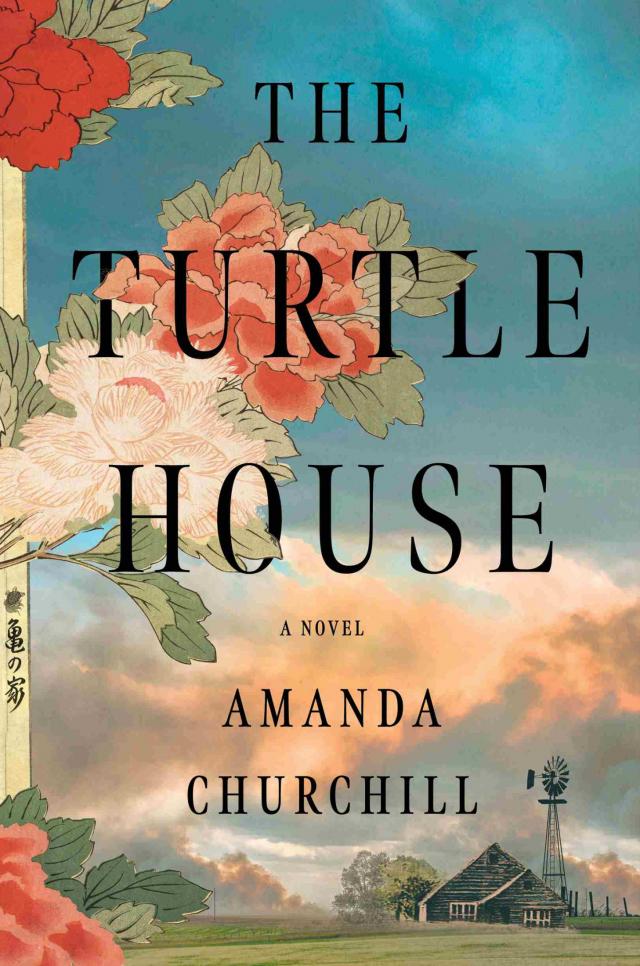
At the granite steps, she looked up and saw a beautiful kawara staring back at her, a minogame turtle with its bushy seaweed tail sculpted behind it, as if floating through the water. It was a moody gray with glints of silica that had been baked into the ceramic. Unlike some she had seen before with menacing mouths, this one had a slight feminine smile, more mischievous than evil. Mineko felt her insides soften. Nothing to fear when such an auspicious creature was watching over her. The word turtle was in her surname, after all. This was destined.
“Hello, sister turtle,” Mineko said in greeting.
She entered into a rather spacious genkan with dirty shelves for shoes and hooks where only cobwebs hung. Moving cautiously, barely breathing, Mineko circled around the house through the engawa, the interior walls on one side, the storm shutters on the other. The air was cold and stale, made worse by Mineko’s silence.
Back at the entrance, Mineko slipped off her shoes and slid open the door that led into the front yoritsuki.
The ceiling reached to the top of the second story, creating a cavernous expanse. Dust motes drifted down and, with one wave of the ofuda, were propelled up again. An old-fashioned square irori was centered in the middle of the main room. A chain dangled from the ceiling with a beautifully wrought hook where a boiling pot had once hung over a fire. The beams were dark with years of smoke. She had never seen a place so magical.
“This is an old house,” she breathed. She gently touched the fusuma. The painted scene was of cranes and turtles, a willow and a brook. More turtles, she said quietly. Mineko loved how they moved slowly but could swim and carried their home on their backs. This place wasn’t haunted, surely, and even if it was, she felt the turtles’ protection. Why, this might be the luckiest kominka in the entire empire. And it was all hers.
The tatami was still in good condition, despite years of small creatures finding their way into the house. A few mousetraps lined the room, along with the skeletal remains of their catches. She climbed the stairs and slowly opened doors to find smaller bedrooms. Very little furniture was left, save for a couple of framed drawings and other odds and ends.
She picked out a room that she would like to have if her family lived in this house, but then thought about this—she would allow her grandparents and her father, but her sister and her mother, they could stay in town. She’d allow Fumiko—she’d get her very own room! And Fumiko’s mother, of course. Mineko slid open the door to the room’s balcony and there, below her, was a green pond, fed by a stream, dammed at the far side. An azumaya was perched at the very edge of the water, its wood gray with age.
Mineko raced down the stairs, grabbed her satchel, and burst outside, forgetting her shoes as she made her way to the water’s edge. Algae floated on the sides, but the center of the pond was clearer due to the delicate current, just enough to keep the middle clean. She ran to the azumaya, feeling it wobble slightly as she bounced on the boards. Lying on her stomach, she let her head and shoulders fall over the side so she could peer beneath. Just as she suspected, the gazebo had been built into the water, and as she wiggled her body back and forth, she saw how the piers jiggled.
“Water rot,” she said, and she liked how grown up she sounded.
Mineko bounced to her feet to explore where the stream went on the other side of the small rock dam. She followed it as it snaked along, growing faster as the property dipped down a small slope. She came upon a low rock wall, and there, just on the other side, the ground fell away and the water became a miniature waterfall. Mineko climbed over the wall and made her way to the edge, testing the soil with her feet. Closer and closer to the edge she went, a few pebbles loosening and tumbling off the side, soundlessly.
Below, the stream joined the river—her village’s river—rushing toward Kadoma.
It was a long drop, but she felt no fear.
Mineko made her way back to the azumaya, spread out her jacket, and sat watching the water bugs land, creating a circular ripple, then taking off again. She opened her satchel, took out a small bag of arare, and popped a few into her mouth, pleased with her unladylike way of eating. She had a book, a canteen of water, and a handkerchief. She chided herself for not bringing a quilt. Stretching out her legs, she let her feet flex and point over the side of the decking. There, just over her big toe on her right foot, she saw movement in the water, something swimming toward her. Mineko again lay on her stomach and flopped over the edge, her fingers nearly touching the still pond.
There were turtles! A whole family of mossy-backed turtles swam near and, getting closer, pried their heads out of the water, their necks as long as possible, then, as if frightened, dove back under. She noticed that below them were fish, swimming over each other like clumsy children. Carp, Mineko thought, but not the pretty bright kind at the fancy park in Osaka. These were silver-white and lazy.
“Oh, you want food, do you?” Mineko took a few crackers and sucked off the spicy coating, spat them out into her hand, and tossed them into the water, where they floated for just a moment before being gobbled up by the first turtle.
“Naughty and greedy! You’re not sharing!” She sucked and spat out more crackers, this time tossing them over the first turtle’s head and toward the others. More cautiously appeared, including a baby, the size of a dolly’s tea saucer.
Mineko couldn’t help but giggle. She jumped up, ran through the grass, tugged at a flower, stuck it in her collar, skipped along the bank, and then, unable to control herself, slipped out of her dress. She waded in, the water warm at top and cool below, the ground squishing and sucking at her feet.
Mineko stuck out her tongue and scrunched up her nose, but still she moved in farther and farther, until the water reached her waist, her chest, her shoulders. Then, looking up at the sun, raising her arms and shouting banzai like she did at school, Mineko disappeared under the water, even daring to open her eyes like one of her new turtle companions that swam nearby.
This is my place. My house, my rules, my ghosts, my turtles.
Mineko played in the water and tramped all over the grounds that day, and when the sun began to slide toward the horizon and her stomach begged for dinner, she packed up her satchel and ran her fingers through her damp hair. She waved goodbye to the minogame before she slipped through the gate. I’ll see you tomorrow.
When she arrived home, Hana said nothing about missing her, as she had not missed her, only realized the quiet of the house. Hana had spent the day leisurely with Hisako, and because Mineko was not missed, her absence was not mentioned to Hiroshi.
Before leaving that night, as she was lighting the lantern that would lead her and her mother home, Fumiko quickly asked if Mineko had seen the ghosts.
“Yes, many ghosts,” Mineko said, watching Fumiko shudder. “But they said I could visit. In fact, they told me I was free to live there if I needed to.”
Fumiko drew in a deep, admiring breath, but when Hana came around the corner, she pushed the girl toward the door.
Chapter 3
Curtain, Texas
March 2, 1999
The night my grandmother’s house burned down, we could see and smell the fire from the highway. It had burned like its shape. A collection of squares. A big square in the middle, two smaller squares, one at either side.
My dad parked, and we ran to where Grandminnie stood under the pecan tree that my great-great-grandfather had planted, its curvy arms reaching to the flames. The fire replicated in her oversized glasses, her face and silver hair reflecting the orange blaze. My great-aunt Dimple and great-uncle Calvin were already there. Dimple had seen the fire from her kitchen window, just a burning dot on her horizon, and had called 911, which had dispatched the volunteer fire department. If my hip hadn’t hurt tonight, I wouldn’t have been up for my pain pills, she had said. Dimple’s arthritic hip was a constant source of consternation, caused originally by a fall from a hayloft when she was a teen. Thank God for that accident so long ago or I would have lost my Minnie.
This is a thing in our family—thanking the heavens for past pain. I don’t know where this concept comes from, Grandminnie certainly doesn’t ever say anything like this. She doesn’t willingly say much about her past at all—and when she does, she doesn’t cut it to pieces and hold it up to see how it was cooked. This, she has insisted many times, is an American thing, and she, she also insists, is not an American.
Oh yes, you are, my mother will always respond, I’ve seen the photos from the day you got your citizenship!
My grandmother will then give her the stare—the straight at your eyes, slightly ajar mouth, about to say something insanely hurtful, but stopping because the receiver is weak and will not be able to withstand judgment. I wish I could get away with such a death stare, a classic Grandminnie move.
She did it the night of the fire when the new sheriff’s deputy questioned her about how the blaze began, how she escaped without a smudge of soot, and why she was carrying a bowling ball bag. To his questions, she was short and sharp, like a dagger.
My mother and father are now recalling this night over oatmeal in the kitchen. They are having a conversation in hushed tones about what is next. Last night, getting a call from the neighbor that my mother-in-law is ON THE ROOF AGAIN, my mother says, is the straw that broke the camel’s back. My father says, I know, I know. It’s dangerous. Yet I’m certain the break-your-neck aspect is not what broke my mother’s camel’s back. But you don’t, she says, you go to work and I’m stuck with her, unless Lia is home to entertain. And Lia—she’s just so . . . My mother emits a long, drawn-out sigh that ends in a little sneeze from her spring allergies.
It’s not that Mom and Grandminnie openly argue, but it’s a matter of boundaries. My mother likes to control hers. My grandmother does as well. My mother is from a good Fort Worth family with firm beliefs on how things are done. My grandmother, I see now, is from a good Kadoman family with equally firm ideals. They are alike because of this, but to ever mutter such a sentiment would be mutinous. And Daddy is in the center of these two quietly conflicting countries, both wanting him like he’s a landlocked valley with considerable natural resources. It’s their great love of this man that helps to keep our family so ridiculously close-knit. It also is why my grandmother has now overstayed her welcome.
She’s still adjusting, my father says, she’ll come to her senses.
Which one? Our daughter or your mother? Mom snaps.
Then there is silence. I listen to them, listening for me.
“Lia, honey, is that you?” Mom has righted her voice. “You’re up late, baby. D’you sleep okay?”
“Good morning, sweetheart!” Dad says cheerfully.
Last night, my grandmother talked to me for a long while, then I plugged in my headphones and listened to what I had recorded. I rewound her description of the turtle house twice.






